Over the last two decades, institutions for higher education such as universities and colleges have rapidly expanded and as a result have experienced profound changes in processes of research and organization. However, the rapid expansion and change has fuelled concerns about issues such as educators' technology professional development. Despite the educational value of emerging technologies in schools, the introduction has not yet enjoyed much success. Effective use of information and communication technologies requires a substantial change in pedagogical practice. Traditional training and learning approaches cannot cope with the rising demand on educators to make use of innovative technologies in their teaching. As a result, educational institutions as well as the public are more and more aware of the need for adequate technology professional development. The focus of this paper is to look at action research as a qualitative research methodology for studying technology professional development in HE in order to improve teaching and learning with ICTs at the tertiary level. The data discussed in this paper have been drawn from a cross institutional setting at Fontys University of Applied Sciences, The Netherlands. The data were collected and analysed according to a qualitative approach.
DOCUMENT

In December of 2004 the Directorate General for Research and Technological Development (DG RTD) of the European Commission (EC) set up a High-Level Expert Group to propose a series of measures to stimulate the reporting of Intellectual Capital in research intensive Small and Medium-Sized Enterprises (SMEs). The Expert Group has focused on enterprises that either perform Research and Development (R&D), or use the results of R&D to innovate and has also considered the implications for the specialist R&D units of larger enterprises, dedicated Research & Technology Organizations and Universities. In this report the Expert Group presents its findings, leading to six recommendations to stimulate the reporting of Intellectual Capital in SMEs by raising awareness, improving reporting competencies, promoting the use of IC Reporting and facilitating standardization.
DOCUMENT

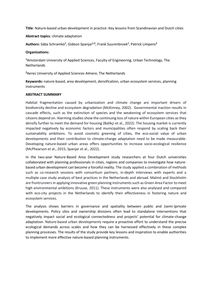
Abstract from AMS Scientific Conference '24, Amsterdam, Netherlands.In the two-year Nature-Based Area Development study researchers at four Dutch universities collaborated with planning professionals in cities, regions and companies to investigate how nature-based urban development can become a forceful reality. The study applied a combination of methods such as co-research sessions with consortium partners, in-depth interviews with experts and a multiple case study analysis of best practices in the Netherlands and abroad.Keywords: nature-based, area development, densification, urban ecosystem services, planning instruments
DOCUMENT
This study aimed to examine which kind of support through professional development activities is offered to teacher educators in the (Dutch) teacher education institutes for primary and secondary education regarding conducting practice-based research and supervising students’ research. Two online surveys were executed among deans and teacher educators to examine their views on institutional policies supporting professional development; the offered activities; their evaluation on the activities and teacher educators further needs for professional development. Results show that little attention is paid to professional development activities and if attention is paid it concerns mainly courses or supervised peer-exchange groups. However, support for professional development of teacher educators in conducting research and supervising students’ research is considered important. Most activities are executed isolated in each institute. A need for more collaboration between institutes on contributing to teacher educators’ professional development and collaboration at a national level is considered important.
DOCUMENT
In this whitepaper (available in Dutch and English) some practical tips for sensory and consumer research during product development are provided.
MULTIFILE

These are hard days for companies: they have to survive in a market that has been hit by a financial crisis. Many countries in Europe have severe problems trying to overcome this financial crisis. The main remedy applied by governments is to cut back on expenditure, but on the other hand it is said that it is important for a country, and especially for companies, to invest in innovation. These innovations should lead to innovative products that will lead to profitability turnovers for these companies and, as a consequence, improve the economic conditions in a country. Universities provide students with engineering competences, like develop innovation, with which they can show a higher degree of ability to answer complex questions such as how to become players in the market again. Teaching students to become more innovative engineers, Fontys University of Applied Sciences, Department of Engineering, has designed a curriculum in which students are educated in the competence innovation. An important element in the process of teaching innovation to students is the approach of inquiring into possibilities of patents. In the second semester of the first year, students can decide to join an innovative project called: ‘The invention project’. The basis of this project is that students are given the opportunity to create their own invention and with their previously acquired knowledge and skills they design, calculate, prototype and present their invention. In a research project, the experiences of students in this Invention Project have been analysed. The goal of this study was to understand what the success factors are for such a project. The basis of this inquiry is a questionnaire to identify the opinions of students. The research was carried out in the spring semester of 2012. In total 31 students were involved in this research. The results show that there was a high degree of student satisfaction about the Invention Project focused on innovation development. Success factors for this project in the first year of the curriculum were seen: 1 to work on own inventions, 2 development of student’s perception of the total product creation process and 3 to make students see the relevance of contacts with real professionals from industry and from the patent office in their own project. Improvements can be made by: 1 helping students more during the creativity stage in the project and 2 to coach them more on the aspect of engineering a successful invention of which they can be proud. This Invention project is a interesting with which collaborations with other universities can be set up.
DOCUMENT

VHL University of Applied Sciences (VHL) is a sustainable University of AppliedSciences that trains students to be ambitious, innovative professionals andcarries out applied research to make a significant contribution to asustainable world. Together with partners from the field, they contribute to innovative and sustainable developments through research and knowledge valorisation. Their focus is on circular agriculture, water, healthy food & nutrition, soil and biodiversity – themes that are developed within research lines in the variousapplied research groups. These themes address the challenges that are part ofthe international sustainability agenda for 2030: the sustainable developmentgoals (SDGs). This booklet contains fascinating and representative examplesof projects – completed or ongoing, from home and abroad – that are linked tothe SDGs. The project results contribute not only to the SDGs but to their teaching as well.
DOCUMENT

Internationalizing curricula. Needs and wishes of alumni and employers with regard to international competencies. Internationalization has become of great importance for universities acrossthe globe. The labour market is becoming international, with internationalopportunities and international competition. Emerging markets such as India, China and Russia are gaining economic power. Global challenges demand world-wide solutions. Production and marketing networks span the globe and various forms of migration have resulted in a large cultural diversity within nations. As a result, societies and labour markets are changing as well. In order to deal with these societal changes adequately and to succeed in today’s labour market, graduates need to be equipped with international competencies. In a survey among 500 chief executives, ICM Research (on behalf of Think Global and The British Council, 2011) showed that employers strongly value staff members who are able to work in an international and multicultural environment. Similar results were found in Diamond et al. (2011), in which ‘multicultural teamwork’ was considered most important. The Hague University of Applied Sciences seeks to prepare its students adequately for the world of tomorrow. The University’s development plans (e.g. HogeschoolOntwikkelingsPlan, HOP 7, 2009-2013 and HOP 8, 2014-2017) indicate that its vision is to train students to be globally-minded professionals with an international and multicultural perspective, who are world-citizens, interested in global issues and able to deal with diversity in a constructive manner. They are to be professionals, who possess the competencies to function well in an international and intercultural environment. Internationalization is therefore high on the agenda of The Hague University of Applied Sciences (THUAS) which is illustrated by the fact that, as of 2014, new students in all academies have to fill 12.5% (30 ECTS) of their four-year Bachelor program with international activities. These activities can range from an internship or semester abroad (student mobility) to participating in full programs of study or minors in which English is the medium of instruction, or an internationally themed minor (Internationalization at Home, IaH). And this is only the beginning. Internationalization is a means, not an end. All THUAS courses are looking into ways in which they can internationalize their curriculum. And in doing so, they need to be innovative (Leask, 2009) and keep in mind the specific needs and wishes of alumni and their employers with regard to international competences. The THUAS research group International Cooperation supports these internationalization policy objectives by investigating various aspects, such as: • The acquisition and development of international competencies among students. • The extent to which lecturers possess international competencies and what their needs and wishes are for further development. • The international competencies THUAS graduates have acquired as part of their degree and how THUAS has stimulated this development. • The international competencies that employers and alumni consider important. Although international competencies and employability have received growing attention in internationalization research, existing studies have mainly focused on: • The effects of study abroad on the development of international competence (cf. Hoven & Walenkamp, 2013). • The effects of an experience abroad (study, internship, voluntary work) on employability. • A more general analysis of the skills employers look for in prospective employees.
DOCUMENT

Lectorale rede
DOCUMENT





