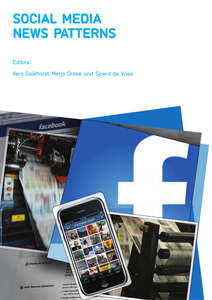
Wereldwijd onderzoek: Hoe gebruiken nieuwsmedia social media? Jongeren lezen geen krant meer, ze kijken op hun smartphone die ze altijd bij de hand hebben. Binnen het lectoraat social media en reputatiemanagement van NHL hogeschool te Leeuwarden heeft een groep internationale studenten in 12 landen onderzoek gedaan. Hierbij hebben ze meer dan 150 social media sites bestudeerd van nieuws media. De resultaten maken deel uit van een internationaal onderzoek van NHL Hogeschool en Haaga Helia University. De onderzoeksvraag was: Wat speelt zich af in de nieuwsmedia? Persbureaus kunnen het overzicht gebruiken om hun social media te optimaliseren. En voor ieder die journalistiek een warm hart toedraagt is het interessante informatie over de nieuwsmedia in een overgangssituatie (2nd edition)
DOCUMENT
full text via link. Wat zijn de ontwikkelingen in social media research, naar wie luisteren we nu eigenlijk in social media, wie is de werkelijke innovator en wie is de werkelijke deler, en wat kunnen merken met klantervaringen? Anita Cox (Insights Director) trapt af met de vraag: Waarom zagen we social media 5 jaar geleden niet aankomen? -
LINK
In this paper we discuss the general approach and choices we made in developing a prototype of a social media monitor. The main goal of the museum monitor is to offer museum professionals and researchers better insight in the effects of their own social media usage and compare this with other actors in the cultural heritage sector. It gives researchers the opportunity to consider communication within the sector as whole. In the research project “Museum Compass” we have developed a prototype of a social media monitor, which contains data of current and historic online activities on Facebook, Twitter, YouTube, Foursquare and Flickr of all registered Dutch museums. We discuss – mostly in a practical sense – our approach for developing the monitor and give a few examples as a result of its usage.
DOCUMENT

This PhD research project is about how Dutch development NGOs use social media for their development projects. For this, the following research question has been investigated: how do Dutch development NGOs use social media to further the development activities of their organisations? The purpose of this study is to understand how development NGOs are trying to get to grips with social media. Given the exploratory nature of this research, a qualitative research approach was adopted. Both case studies and the grounded theory method were used for this study. This combination is ideal because with a case study one tries to understand, or explore a phenomenon, whereas, in grounded theory studies, one tries to build theory. Given that this study is concerned with how Dutch development NGOs perceive social media for their development projects, an interpretive paradigm seems appropriate. The grounded theory methodology for this research is consistent with the epistemology of interpretivism. The combination of case study research and grounded theory works well for theory building and has been applied in Information Systems and ICT for Development studies before. As the use of theory before data collection is in opposition to the principle idea of the grounded theory methodology, in which theory emerges from the data, this needs to be addressed when combining case studies and grounded theory. This issue was resolved by using an initial highlevel conceptual framework as a guiding instrument for both the noncommittal literature research and for the conceptualisation of the research problem, whilst not distorting the emergence of theory from the data. This study focuses on formally organised development NGOs who receive funding from the Dutch Ministry of Foreign Affairs for their development projects. From the approximately 100 organisations, fourteen NGOs were selected for this study. The choice of fourteen NGOs was driven by a theoretical sampling strategy. Data was collected via semi-structured interviews with 18 respondents and field-notes of meetings or events of 14 development NGOs. The data was analysed using the Glaserian coding procedure of grounded theory, starting with open coding, followed by selective coding, and ending with theoretical coding. Three major themes (or core categories as they are called in the grounded theory method), were identified. This study's first contribution is captured in the theme ‘NGO Enacting Values in Development’. This is about how an organisation’s values are enacted in the context of international development. The organisational mixture of development mind-sets influences organisational activities in development. The ideological trends that are stimulated by societal and technological changes have an impact on the organisation’s development strategy and the strategic collaboration network of development NGOs. The second contribution of this study is captured in the theme ‘NGO’s Views on Social Media Use’. This core category discusses the organisation’s view on the meaning of social media and includes the four following categories: technological, individual, collective and contextual views attributed to organisational social media. The four categories empirically demonstrate the concept of affordance clusters and the connections between them. The study’s third contribution is captured in the theme ‘NGO’s Use of Social Media in Development’, encompassing the social media activities of the studied development NGOs in their development projects. This has led to an assessment framework of organisational social media use by development NGOs, constructed by cross-referencing the organisational goals of development NGOs to the social media activity areas in the context of development. These themes represented by three core categories are inter-related. Feedback loops between NGO’s values in development, views on social media, and the actual uses of social media for development purposes have been discerned. This grounded theory study aims to build an initial theory of how NGOs might approach the use of social media in a development context. This qualitative study has produced some new concepts. This study has led to a substantive theory in the context of international development. Furthermore, this substantive theory is compared with three theory lenses, when applied on the data collected for this PhD research, in their ability to identify similar concepts as reached with the substantive theory following the grounded theory method. Finally, the thesis presents some avenues for future research that may help expand the substantive theory that has been developed under this research to formal theory
LINK
A social media architect is an appealing new profession that entails crossovers between communication and IT & Design. There are no study programmes for this job. Important questions are how to interest secondary school pupils for such a new job, and how to prepare them for these jobs or jobs that do not even exist today? This research aims to set an example by presenting a realistic job profile of a social media architect by linking the ‘21st century skills’ to the context in which he/she operates.
DOCUMENT

Deze casestudie geeft inzicht in verschillende soorten kennis die kenmerkend zijn voor applied design research. Er wordt onderscheid gemaakt tussen kennis over de huidige situatie, over wenselijke alternatieven en over effectieve oplossingen om daar te komen. Ofwel, kennis hoe het is, kennis over hoe het kan zijn en kennis over hoe het zal zijn als we effectieve oplossingen toepassen. Elk van deze soorten kennis heeft andere kwaliteitscriteria.
DOCUMENT

In the past two years [2010-2012] we have done research on the visitor experience of music festivals. We conducted several surveys asking festival visitors for demographic variables, taste in music, their motivation for visiting festivals, mentalities and the evaluation of the festival. We also asked for the use of social media before, after and during the festival. Results show that visitors using social media have a significantly different festival experience from users that do not use social media before, during or after the festival. Results on difference in festival satisfaction are mixed.
DOCUMENT
From the author: " This short paper argues for the need for discussion on the role social media could have in the research life cycle, particularly for Information Systems (IS) scholars. ICTs are pervasive, and their societal impact is profound. Various disciplines including those of social sciences are present in the online discourse and join the public debate on societal implications of ICTs and scholar are familiar with web tools for publishing. Information Systems scholars could not only further explore the possibilities for joining that online discourse, but also could explore the potential social media may have for activities related to the research life cycle. In this paper we do not focus solely on social media as a data collection source but regard their merits as a channel for scholarly communication throughout the whole research life cycle, from the start of getting inspired to conduct a research, finding collaboration partners or funding, through suggestions for literature, to the stage of research dissemination and creating impact beyond the own scientific community. This paper contributes an original approach to research communication by combining the research life cycle with practical insights of how social media can be applied throughout each phase of that lifecycle. We conclude with some questions debating the stance that (future) IS scholars are prepared to become the digital scholar that can manoeuvre well on social media for scholarly communication."
DOCUMENT
Uit het artikel: "Social media zijn alle internettoepassingen waarmee het mogelijk is om informatie met elkaar te delen op een gebruiksvriendelijke en aantrekkelijke wijze. Niet alleen informatie in de vorm van tekst, maar ook geluid en beeld worden gedeeld via social media websites. Bekende voorbeelden zijn Facebook, Hyves, YouTube, Flickr, LinkedIn en Twitter. Onderzoekers van de Universiteit Twente gaan in opdracht van het Ivoren Kruis interviews houden bij dentale praktijken. Met uw kennis en mening worden vervolgens nieuwe methoden ontwikkeld voortoepassing van social media voor het bevorderen van mondgezondheid bij uw patiënten."
DOCUMENT

This longitudinal, quantitative study contributes to the debate on technology-based professional development by examining the extent to which a learning (LinkedIn) intervention in a university setting affects an individual’s social media use for professional development, and the extent to which this relates to self-reported employability. In addition, we investigated how this relationship is moderated by an individual’s motivation to communicate through social media (LinkedIn). Based on social capital theory and the conservation of resources theory, we developed a set of hypotheses that were tested based on longitudinal data collected from university employees (N = 101) in middle- and high-level jobs. First, in line with our expectations, social media use for professional development was significantly higher after the learning intervention than before. Second, partially in line with our expectations, social media use for professional development was positively related with the employability dimension anticipation and optimization. Third, contrary to our expectations, motivation to communicate through social media (LinkedIn) did not have a moderating role in this relationship. We concluded that the learning intervention has the potential to foster social media use for professional development, and in turn, can contribute to individuals’ human capital in terms of their employability. Hence, the intervention that forms the core of this empirical research can be a sustainable and promising human resource management (HRM) practice that fits the human capital agenda.
DOCUMENT




