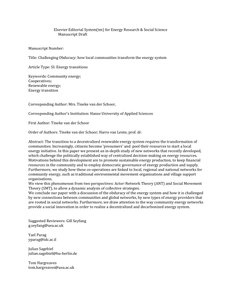
Abstract: The transition towards renewable and sustainable energy is being accompanied by a transformation of communities and neighbourhoods. This transition may have huge ramifications throughout society. Many cities, towns and villages are putting together ambitious visions about how to achieve 100% sustainable energy, energy neutrality, zero carbon emission or zero-impact of their communities. We investigate what is happening at the local community level towards realizing these ambitions from a social perspective. We use the case study approach to answer the following question: how do local community energy initiatives contribute to a decentralized sustainable energy system? We find that especially the development of a shared vision, the level of activities and the type of organisation are important factors of the strength of the ‘local network’.

What’s online video today, fifteen years into its exponential growth? In the age of the smart phone, video accompanies, informs, moves, and distracts us. What started off with amateur prosumers on YouTube has spread to virtually all communication apps: say it with moving images. Are you addicted yet? Look into that tiny camera, talk and move the phone, show us around, and prove the others out there that you exist!With this third reader the Video Vortex community — initiated in 2007 by the Instituteof Network Cultures — proves that it is still alive and kicking. No matter its changes, the network is still driven by its original mission to develop a critical vocabulary for this rapidly spreading visual culture: what are the specific characteristics of online video in terms of aesthetics and political economy of image production and distribution, and how do they compare to film and television? Who is the Andre Bazin of the YouTube age? Honestly, why can’t we name a single online video critic? Can we face the fact that hardly anyone is using the internet? What are you going to do with that 4K camera in your smartphone? Have we updated Marshall McLuhan’s hot and cold media for our digital era yet? Who dares? We see the Woman with a Smartphone Camera in action, but who will be our Vertov and lead the avant-garde? Who stops us? Let us radically confront the technological presence as it is and forget the pathetic regression to past formats: radical acceptance of the beautiful mess called the net.
MULTIFILE

The energy transition requires the transformation of communities and neighbourhoods. It will have huge ramifications throughout society. Many cities, towns and villages have put together ambitious visions about how to achieve e.g. energy neutrality, zero-emission or zero-impact. What is happening at the local level towards realizing these ambitions? In a set of case study’s we investigate the following questions: How are self-organized local energy initiatives performing their self-set tasks? What obstacles are present in the current societal set-up that can hinder decentralized energy production? In our cases local leadership, vision, level of communication and type of organisation are important factors of the strength of the ‘local network’. (Inter)national energy policy and existing energy companies largely determine the ‘global’ or outside network. Stronger regional and national support structures, as well as an enabling environment for decentralized energy production, are needed to make decentralized sustainable energy production a success.

Dit projectvoorstel is gericht op het samen met lokale coöperaties ontwikkelen van innovatieve energiediensten, onder meer om problemen als netcongestie het hoofd te bieden. Deze energiediensten bieden lokale coöperaties kansen om economisch renderende taken op te pakken. Bovendien worden de mogelijkheden voor regionale energiediensten onderzocht. Met regionale samenwerking kunnen lokale coöperaties worden ondersteund, kennis van netbeheer verworven worden en gezamenlijk zijn lokale coöperaties een effectieve gesprekspartner voor netbeheerders. Het project kent een vijftal werkpakketten, die ieder een specifiek onderwerp bestrijken. In werkpakket 1 wordt samen met lokale energiecoöperaties gewerkt aan het verkennen van de behoeften aan en mogelijkheden van lokale energiediensten. Hoe kunnen coöperaties zinvol gebruik maken van de (vernieuwde en oude) Experimentenregeling? In werkpakket 2 wordt onderzocht welke mogelijkheden er zijn om op regionaal niveau coöperatieve energiediensten te leveren, zoals flexibiliteitsdiensten, energieopslag en vraagzijdesturing. In werkpakket 3 wordt in kaart gebracht welke mogelijkheden blockchain-achtige oplossingen bieden voor onderlinge levering van energie door prosumers en lokale energiecoöperaties. Werkpakket 4 onderzoekt de juridische aspecten van onder meer het EU-Clean Energy Package en de Experimentenregeling in relatie met lokale duurzame energie. Op basis daarvan wordt een ‘juridische routekaart’ ontwikkeld die coöperaties zal helpen om de juridische routes van louter opwek naar een actievere rol in het energiesysteem te verkennen. Werkpakket 5 tenslotte is gericht op coördinatie van het project en verspreiding van de resultaten in de vorm van netwerkbijeenkomsten, een nieuwsbrief en artikelen. Het project sluit nauw aan bij verschillende onderwijsmodules van de Hanzehogeschool, zoals de Innovatiewerkplaats (IWP) Energy Markets van Entrance en de Master Energy For Society.
In this project I will examine models of local energy production and management, comparing the nine Zero emission neighbourhoods, as developed and monitored by the ZEN research centre at NTNU with the Friesian towns that are part of a new research project in the Netherlands (see above). Secondly, connected to this empirical part, I aim to examine and compare the policies and opportunities for prosumers and small and/ or cooperative businesses in Norway and The Netherlands. In this project I will examine models of local energy production and management, comparing the nine Zero emission neighbourhoods, as developed and monitored by the ZEN research centre at NTNU with the Friesian towns that are part of a new research project in the Netherlands (see above). Secondly, connected to this empirical part, I aim to examine and compare the policies and opportunities for prosumers and small and/ or cooperative businesses in Norway and The Netherlands.
InleidingRuimte voor Nieuwe Energie is een RAAK-project dat wordt uitgevoerd in het kader van het project Energie+Dorp. In het onderzoek wordt gekeken hoe grotere, complexe projecten door lokale initiatieven worden uitgevoerd.In Nederland is in snel tempo een nieuwe decentrale energiesector aan het ontstaan, bestaande uit nieuwe en jonge Decentrale Energie Bedrijven (DEB) en hun netwerk van toeleverende bedrijven. Deze nieuwe groep van MKB bedrijven wil met dit onderzoeksproject grotere technologische innovaties op het gebied van lokale duurzame energie succesvol realiseren. Het gaat hierbij om kapitaalintensieve en complexe technologische innovatie op het gebied van lokale energie zoals een warmtenet, biovergister, windturbines, waterkrachtcentrale of zonneveld, en de integratie daarvan in het lokale energie systeem.Voor DEB is schaalvergroting belangrijk; toename van het aantal participanten en klanten maakt een toename in productie van lokale energie noodzakelijk, en ook het aantrekken van meer kapitaal en andere resources is daarbij van belang. Tegelijkertijd ziet een groep meer gevestigde MKB toeleveranciers een nieuwe markt op het gebied van lokale energie ontstaan. Samen willen deze bedrijven innovatieve technologische projecten van grotere omvang realiseren.De nieuwe ontstane groep van DEB is niet los te zien van een recente en veel belovende maatschappelijke ontwikkeling; de opkomst van de participatiesamenleving waarin burgers zich verenigen om zelf naar eigen behoefte de collectieve goederen en diensten te organiseren. De nieuwe DEB komen over het algemeen voort uit deze lokale bewegingen en ontwikkelen zich momenteel tot professionele en uiterst innovatieve MKB bedrijven. Het is voor DEB een enorme stap om na kleinschalige activiteiten, zoals collectieve inkoopacties voor zonnepanelen en het doorverkopen van hernieuwbare energie ineens een windmolen of warmtenet te realiseren. Nu DEB een schaalsprong willen maken, zijn ze op zoek naar kennis en kunde om ook grote en complexe technologische projecten met succes te kunnen realiseren.Ruimte voor Nieuwe EnergieIn toenemende mate nemen bewoners en gebruikers van gebouwen het initiatief in eigen hand op het gebied van de energievoorziening. Mensen worden prosumers (naast consumer van energie is men ook producer) die zich verenigen in collectieven. De afgelopen jaren zijn er honderden lokale energie initiatieven (LEI's) opgericht waar bewoners en gebruikers van gebouwen de krachten bundelen om lokale energieproductie m.b.v. zonnepanelen, windmolens of biomassa te realiseren, en gezamenlijk maatregelen nemen voor energiebesparing[1]. Het gebied van de noordelijke provincies telt momenteel tientallen LEI's en wordt frequent aangehaald als voorbeeldregio met interessante organisaties zoals Grunneger Power en NLD. De laatste jaren is er door onderzoek vanuit het Kenniscentrum NoorderRuimte inzicht gegenereerd in de aard en het functioneren van deze LEI's en de doelstellingen die ze op lokaal niveau willen realiseren (van der Schoor & Scholtens 2015; van der Blonk et al. 2013).Deze ontwikkelingen sluiten ook aan bij de ambities van veel gemeenten in Noord-Nederland om energieneutraal te worden, werkgelegenheid te genereren en de uitvoering van deze beleidsdoelstellingen voornamelijk bij bewoners, gebruikers van gebouwen en lokale ondernemers neer te leggen. Het opzetten van een eigen lokale duurzame energievoorziening heeft daarnaast ook nog andere voordelen voor lokale gemeenschappen:* duurzaam geproduceerde energie* betrokkenheid van burgers bij de eigen energievoorziening* meer voorzieningszekerheid* werkgelegenheid, en impuls voor de lokale economieVraagstellingWat zijn de lessen die kunnen worden getrokken uit al gerealiseerde grote, complexe projecten van andere DEB met betrekking tot succes- en faalfactoren? Hoe kunnen de verschillende actoren het beste worden ingezet, en in welke fase? Wat voor aanbevelingen kunnen worden gegeven om de kans op succes te vergroten?DoelDoelstelling van het project is een bijdrage te leveren aan het succesvol realiseren van complexe en kapitaalintensieve technologische innovatie op het gebied van lokale energie (zoals een warmtenet, biovergister, windturbines, waterkrachtcentrale of zonneveld) en dit te integreren in het lokaal energie systeem van een dorp, regio of stadswijk. Met dit project willen de partijen in het consortium een bijdrage leveren aan het versnellen van de transitie naar duurzame lokale energie in Nederland..OnderzoeksresultatenEr zijn vier projecten die als case in het onderzoek opgenomen zijn. Deze vier cases zijn geselecteerd in samenwerking met het netwerk van DEB en toeleverende MKB bedrijven:1) Project Noorderplantsoen (Groningen) energieneutraal (Grunneger Power);2) Project Duurzame Energie via lokale initiatieven (NLD);3) Project Molenstroom (Reggestroom);4) Project Zonnestroom voor verschillende doelgroepen (Trynergie).Het overkoepelende doel van het onderzoek is het versnellen van de transitie naar duurzame lokale energie in Nederland, door bij te dragen aan het succesvol realiseren van complexe en kapitaalintensieve technologische innovatie op het gebied van lokale energie (zoals een warmtenet, biovergister, windturbines, waterkrachtcentrale of zonneveld) en dit te integreren in het lokaal energie systeem. Concreter uitgewerkt richting de opzet van het onderzoeksprogramma zijn drie sub-doelen geformuleerd.1) Inzicht krijgen in welke actoren en factoren een belangrijke rol spelen bij het realiseren van complexe technologische innovaties op het gebied van lokale energie.2) Vanuit deze kennis bijdragen aan het realiseren van 4 concrete en real-life succesvolle technologische innovaties op het gebied van lokale energie.3) Het aantal en de succeskans van technologische innovaties op het gebied van lokale energie in Nederland vergroten door de inzichten en resultaten van het onderzoek openlijk te delen.ValorisatieGedurende de derde fase van het onderzoek worden de resultaten van het onderzoek beschreven, verspreid naar MKB bedrijven in het werkveld, en gepubliceerd in relevante media en wetenschappelijke tijdschriften (werkpakket 7). In het schema van Yin (zie Afb 6. Case Study Method (Yin, 2013)) heet deze fase 'Analyze and Conclude'. Nadat alle vier case studies zijn afgerond dienen de resultaten en conclusies bepaald te worden en met elkaar vergeleken om tot case-overstijgende conclusies en inzichten te komen. Dit zal worden uitgewerkt in een eindrapport over de case studies. Deze case study inzichten kunnen vervolgens leiden tot finale aanpassingen van het model van factoren en actoren wat dan inmiddels in de vier cases is getoetst. Deze finale versie van het model gecombineerd met de empirische toetsing in de case studies wordt vervolgens beschreven in een wetenschappelijk artikel voor publicatie in een internationaal journal. Daarnaast worden de opgedane inzichten ook verwoord in als richtlijnen en adviezen in een Handboek voor Decentrale Energie Bedrijven over welke factoren en actoren van belang zijn voor het realiseren van grote complexe projecten op het gebied van lokale energie, en hoe die te implementeren in de eigen projecten. Handboek wordt verspreid via websites en kanalen van de samenwerkingspartners in het consortium.Er zijn vier projecten die als case in het onderzoek opgenomen zijn. Deze vier cases zijn geselecteerd in samenwerking met het netwerk van DEB en toeleverende MKB bedrijven:1. Project Noorderplantsoen (Groningen) energieneutraal (Grunneger Power);2. Project Duurzame Energie via lokale initiatieven (NLD);3. Project Molenstroom (Reggestroom);4. Project Zonnestroom voor verschillende doelgroepen (Trynergie).Het overkoepelende doel van het onderzoek is het versnellen van de transitie naar duurzame lokale energie in Nederland, door bij te dragen aan het succesvol realiseren van complexe en kapitaalintensieve technologische innovatie op het gebied van lokale energie (zoals een warmtenet, biovergister, windturbines, waterkrachtcentrale of zonneveld) en dit te integreren in het lokaal energie systeem. Concreter uitgewerkt richting de opzet van het onderzoeksprogramma zijn drie sub-doelen geformuleerd.1. Inzicht krijgen in welke actoren en factoren een belangrijke rol spelen bij het realiseren van complexe technologische innovaties op het gebied van lokale energie.2. Vanuit deze kennis bijdragen aan het realiseren van 4 concrete en real-life succesvolle technologische innovaties op het gebied van lokale energie.3. Het aantal en de succeskans van technologische innovaties op het gebied van lokale energie in Nederland vergroten door de inzichten en resultaten van het onderzoek openlijk te delen.