In het hoger beroepsonderwijs moeten studenten praktijk- en beroepsgerichte teksten schrijven zoals gezinsanalyses (in pedagogische opleidingen), verslagen van praktijkproeven (in technische opleidingen), enzovoort. Daarbij gelden vorm- en inhoudseisen van het schrijfproduct, wordt het gebruik van vak- en academische taal verwacht en moet de student zijn vakkennis correct benutten en verwoorden. Voor hbo-docenten betekent dit dat zij idealiter aandacht besteden aan ontwikkeling van vakkennis én aan taalontwikkeling bij hun studenten – bij voorkeur geïntegreerd. Om hbo-docenten hierin te trainen zijn lessen van enkele van hun collega’s gefilmd als good practices.
DOCUMENT

The European Manifesto for Inclusive Learning is an initiative of the University of Florence to promote adult education for migrants and refugees. The program seeks to provide “a concrete tool for adult educators to promote adult learning in their local context”. In order to achieve this goal, eight European Union partners in different EU countries collaborated intensively for 1 ½ year to exchange experiences, expand opportunities and to seek to promote a more coordinated and integrated approach. Each partner collected case studies of good practices using a common tool for collecting data. The results of the Dutch partner, The Hague University of Applied Sciences are presented here. Seven cases have been studied with very different, mainly informal ways of mutual learning in the Netherlands. First the Manifesto is described in more detail. This is followed by a sketch of refugee flows to the Netherlands and the Dutch asylum system. After these chapters, the different cases are presented, followed by a conclusion and recommendations based on the Dutch good practices.
DOCUMENT

Introduction: The health-promoting school (HPS) approach was developed by the World Health Organization to create health promotion changes in the whole school system. Implementing the approach can be challenging for schools because schools are dynamic organizations with each a unique context. Many countries worldwide have a health promotion system in place in which healthy school (HS) advisors support schools in the process of implementing the HPS approach. Even though these HS advisors can take on various roles to provide support in an adaptive and context-oriented manner, these roles have not yet been described. The current study aims to identify and describe the key roles of the HS advisor when supporting schools during the dynamic process of implementing the HPS approach. Methods: The study was part of a project in which a capacity-building module was developed for and with HS advisors in the Netherlands. In the current study, a co-creation process enabled by participatory research was used in which researchers, HS advisors, national representatives, and coordinators of the Dutch HS program participated. Co-creation processes took place between October 2020 and November 2021 and consisted of four phases: (1) a narrative review of the literature, (2) interviews, (3) focus groups, and (4) a final check. Results: Five roles were identified. The role of “navigator” as a more central one and four other roles: “linking pin,” “expert in the field,” “critical friend,” and “ambassador of the HPS approach.” The (final) description of the five roles was recognizable for the HS advisors that participated in the study, and they indicated that it provided a comprehensive overview of the work of an HS advisor in the Netherlands. Discussion: The roles can provide guidance to all Dutch HS advisors and the regional public health organizations that employ them on what is needed to provide sufficient and context-oriented support to schools. These roles can inspire and guide people from other countries to adapt the roles to their own national context.
DOCUMENT

In deze rapportage schetsen we praktijkvoorbeelden van activiteiten en samenwerkingsrelaties die binnen de bredeschoolcontext tot stand zijn gekomen. Het is geen uitputtend overzicht van wat goed gaat op de ABC-scholen, maar een selectie, die duidelijk maakt op welke manier de samenwerking tussen partijen uitwerkt op kinderen en hun opgroeien. De gekozen onderzoeksmethoden maakten het mogelijk om de bredeschoolpraktijken van meerdere kanten te belichten. Dit levert een veelzijdig beeld op: enerzijds bracht het traject kennis over de complexiteit van de samenwerking binnen de brede school; anderzijds verkregen we inzicht in de wijze waarop opbrengsten in beeld kunnen worden gebracht. Het doel van deze rapportage is te beschrijven hoe brede scholen vanuit hun visie en binnen gestelde kaders kunnen laten zien wat een goede brede school is.
DOCUMENT

Educational institutions and vocational practices need to collaborate to design learning environments that meet current-day societal demands and support the development of learners’ vocational competence. Integration of learning experiences across contexts can be facilitated by intentionally structured learning environments at the boundary of school and work. Such learning environments are co-constructed by educational institutions and vocational practices. However, co-construction is challenged by differences between the practices of school and work, which can lead to discontinuities across the school–work boundary. More understanding is needed about the nature of these discontinuities and about design considerations to counterbalance these discontinuities. Studies on the co-construction of learning environments are scarce, especially studies from the perspective of representatives of work practice. Therefore, the present study explores design considerations for co-construction through the lens of vocational practice. The study reveals a variety of discontinuities related to the designable elements of learning environments (i.e. epistemic, spatial, instrumental, temporal, and social elements). The findings help to improve understanding of design strategies for counterbalancing discontinuities at the interpersonal and institutional levels of the learning environment. The findings confirm that work practice has a different orientation than school practice since there is a stronger focus on productivity and on the quality of the services provided. However, various strategies for co-construction also seem to take into account the mutually beneficial learning potential of the school–work boundary.
LINK
Mathematics teacher educators in primary teacher education need expert knowledge and skills in teaching in primary school, in subject matter and research. Most starting mathematics teacher educators possess only part of this knowledge and skills. A professional development trajectory for this group is developed and tested, where a design based research is used to evaluate the design. This paper describes the professional development trajectory and design. We conclude that the professional development design should focus on mathematical knowledge for teaching, should refer to both teacher education and primary education, should offer opportunities for cooperative learning, and need to use practice based research as a developmental tool.
DOCUMENT

The main question that leads the focus in this study is: What is the contribution of the school environment to the resilience of middle-adolescent students? Before going into the background and rationale of this study I will specify the terms used in this research question: - Contribution: In this study I will use the dynamic term contribution instead of the term effect because I will not measure the causal influence in a statistical way but I will explore the relationship between school environment and middle-adolescents resilience in terms of dynamic, reciprocal interactions. - School environment: With the term school environment I refer to all possible aspects of the immediate environment constituted by the school as a system in which the middle-adolescent is interactively participating. These aspects can include teachers as well as the school building as well as the lunch breaks and extramural activities. No framed description of this term will be postulated beforehand because the school environment will be studied from the viewpoint of the middle-adolescents. It is the middle-adolescents description of the term school environment that is the focus of this study. - Resilience: Before constructing the term resilience in a detailed manner in Chapter Two I will use the term to denote the ability to bounce back after stressful experiences. - Middle-adolescent: a 14-or 15-year old girl or boy. I will elaborate on the reason for the focus on this age group in paragraph 2.1.
DOCUMENT

In dit rapport worden doel en opbrengsten van het Project Grensoverschrijdende Integrale Leerlingenzorg (GIL) beschreven. Looptijd van het project: april 2002 t/m oktober 2005. Ingegaan wordt op de verrichte werkzaamheden, de bereikte resultaten, de neveneffecten en de grensoverschrijdende meerwaarde. In het rapport wordt melding gemaakt van de publicaties (2 boeken) en 3 DVD's. Verder wordt het rapport vergezeld van een compilatie-dvd waarop impressies zijn vastgelegd van de GIL-thema's, het onderzoek en de conferenties. Dit rapport is in 35-voud geleverd aan de stuurgroep van Interreg IIIA van Euregio Benelux Middengebied. De publicatie is als interne publicatie op te vragen bij Fontys OSO.
DOCUMENT
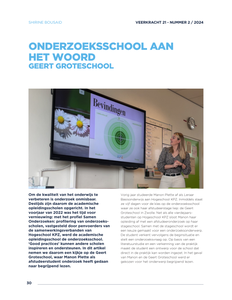
Om de kwaliteit van het onderwijs te verbeteren is onderzoek onmisbaar. Destijds zijn daarom de academische opleidingsscholen opgericht. In het voorjaar van 2022 was het tijd voor vernieuwing: met het profiel Samen Onderzoeken: profilering van onderzoeksscholen, vastgesteld door penvoerders van de samenwerkingsverbanden van Hogeschool KPZ, werd de academische opleidingsschool de onderzoeksschool. ‘Good practices’ kunnen andere scholen inspireren en ondersteunen. In dit artikel wordt een kijkje genomen op de Geert Groteschool, waar Manon Plette als afstudeerstudent onderzoek heeft gedaan naar begrijpend lezen.
DOCUMENT
In dit artikel wordt de literatuur verkend op het terrein van een meer sociaalparticipatieve benadering van actief burgerschap. In deze literatuur wordt de ontwikkeling van burgerschap verbonden met de noodzaak zicht te ontwikkelen op handelingscontexten die voor zowel burgers als sociale professionals van belang zijn. We verkennen relevante literatuur van onder andere De Tocqueville, Dewey, Putnam, Lichterman en Biesta. Door aandacht te besteden aan burgerschap als praktijk beogen we dichter op de huid van het werk van sociale professionals te kruipen, waardoor de huidige ontwikkelingen rondom de bevordering van actief burgerschap bevraagd kunnen worden. Wat deze literatuurverkenning in beeld brengt is dat actief burgerschap niet tot bloei komt vanuit een opgelegde moraal, maar verbonden dient te worden met het dagelijkse handelen van burgers, waarin het “al doende leren” samen op gaat met de ontwikkeling van betekenisvolle praktijken. Sociale professionals hebben vooral tot taak dit type praktijken te ondersteunen en te faciliteren.
DOCUMENT




