MULTIFILE
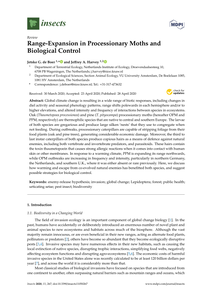
Global climate change is resulting in a wide range of biotic responses, including changes in diel activity and seasonal phenology patterns, range shifts polewards in each hemisphere and/or to higher elevations, and altered intensity and frequency of interactions between species in ecosystems.Oak (Thaumetopoea processionea) and pine (T. pityocampa) processionary moths (hereafter OPM and PPM, respectively) are thermophilic species that are native to central and southern Europe. The larvae of both species are gregarious and produce large silken ‘nests’ that they use to congregate when not feeding. During outbreaks, processionary caterpillars are capable of stripping foliage from theirfood plants (oak and pine trees), generating considerable economic damage. Moreover, the third to last instar caterpillars of both species produce copious hairs as a means of defence against naturalenemies, including both vertebrate and invertebrate predators, and parasitoids. These hairs contain the toxin thaumetopoein that causes strong allergic reactions when it comes into contact with humanskin or other membranes. In response to a warming climate, PPM is expanding its range northwards, while OPM outbreaks are increasing in frequency and intensity, particularly in northern Germany,the Netherlands, and southern U.K., where it was either absent or rare previously. Here, we discuss how warming and escape from co-evolved natural enemies has benefitted both species, and suggest possible strategies for biological control.
DOCUMENT
This research concerning the experience and future of zoos was carried out from 2011-2012 and takes regional ideas concerning Zoo Emmen as well as global visions into account. The research focuses partly on Zoo Emmen, its present attractions and visitors while also comparing and contrasting visions on the future in relationship to other international zoos in the world. In this way, remarkable experiences and ideas will be identified and in the light of them, it can serve as inspiration for stakeholders of zoos at large. The main research subject is a look at the future zoos in view of: The Zoo Experience – an international experience benchmark; The Zoo of the Future – a Scenario Planning approach towards the future; The virtual zoo - zoo’s in the internet domain.
DOCUMENT

For twenty years, typical outdoor lifestyle sports like rafting, snowboarding and rock climbing, which used to be exclusively practised in natural environments, are being offered in controlled artificial settings. This process can be described as 'the indoorisation of outdoor sports'. With this development, questions of authenticity arise. Are these new, commercial forms still authentic lifestyle sports? And can we consider the participants in these indoorised lifestyle sports as authentic? There has been a discussion about authenticity in lifestyle sports since its worldwide popularisation and it is worth to reconsider this discussion against the background of new, commercial versions of lifestyle sports. Therefore, in this paper a qualitative analysis is offered about the consumption of a constructed authenticity in a cultural context increasingly characterized by artificialization.
DOCUMENT
Immersive technologies are redefining and revolutionizing the staging of experiences and co-creation of value, implicating the management of customer experiences. However, limited studies have looked at the role of immersive technologies as part of the customer experience management (CXM) process. Incorporating the concepts of experience economy and value co-creation, this study proposes a dynamic CXM framework that highlights the emerging field of immersive technologies like augmented and virtual reality as part of business and marketing research. The framework acts as a guide for researchers and industry practitioners to initiate immersive technology ventures that are rooted in the co-creation and management of customer experiences
MULTIFILE
De kranten staan er vol van. In veel sectoren is er sprake van een schrijnend personeelstekort: Schiphol heeft grote problemen om beveiligers en bagage-afhandelaren te vinden, de horeca kampt met grote personeelstekorten waardoor restaurants gedwongen worden de zaak op bepaalde dagen gesloten te houden, winkels moeten sluiten omdat ze geen personeel kunnen vinden, wachttijden bij de contactcentra lopen op omdat er te weinig mensen zijn om vragen te beantwoorden. De klantbeleving staat hierdoor in een aantal sectoren zwaar onder druk. Er wordt begrip gevraagd aan de klanten voor de langere wachttijden. Soms hebben klanten dat wel, maar vaak ook niet. Denk aan al die mensen die op Schiphol gefrustreerd staan te wachten voordat ze kunnen inchecken, en die hierdoor hun vlucht dreigen te missen. Is het in deze tijden van crisis nog zinvol om aan het optimaliseren van klantbeleving te werken als je niet genoeg mensen hebt om de primaire processen goed op orde te krijgen?
LINK
In een aantal sectoren staat de klantbeleving zwaar onder druk vanwege personeelstekort. Is het in deze tijd dus nog wel zinvol om de customer experience proberen te verbeteren als er niet voldoende mensen zijn om het primaire proces goed op de rails te hebben.
LINK
Helen Kopnina explains how some pivotal events in her personal life have led to the development of an appreciation of Nature. This article also reflects on whether the love of Nature or care for the environment is learned or inherited. https://www.ecologicalcitizen.net/article.php?t=ecocentrism-personal-story LinkedIn: https://www.linkedin.com/in/helenkopnina/
MULTIFILE

Within large service organizations there are currently two trends visible. These trends seem to be diametrically opposed. On the one hand organizations face increasing price pressure and thus a pressure to cut costs. One of the consequences of this trend is that organizations are increasingly encouraging customers to make more use of digital communication channels. At the same time, companies find it important to know their customers in order to respond adequately to their needs. To do this, organizations must have a certain degree of personal involvement to their customers and they must have regular personal contact. It is assumed that both trends – digitisation and personalisation – will have a strong impact on customer experience and (perhaps) on the relational models customers use. If it is true that relational models - so the way in which people perceive and assess a relationship - play a role in the perception of the customer, it is also interesting to know if it is possible to influence these relational models. During the last fifty years much research has been done into the possibilities to influence customers by using subliminal priming techniques. In these techniques thoughts and feelings are unconsciously activated by showing people certain words or images (eg Bargh, Chen & Burrows, 1996; Dijksterhuis, 2005). In recent years a number of experiments were performed in which customers were unconsciously primed at some type of relationship (eg Aggarwal, 2004; McGraw & Tetlock, 2005; Tuk, Verlegh, Smidts & Wigboldus, 2009). These experiments showed that it is possible to activate a certain type of relationship. The experiments however the researchers used scenario’s based on an interpersonal relationship, and often to a fictitious relationship. The question is whether priming techniques also work for an already existing and more complex relationship between an organization and its customers. From 2010-2013 we conducted research for six large service providers in banking, insurance, utilities and social welfare to discover what the customer experience of these organisations, what role relational models played in customer experience and whether it was possible to influence these relational models. The research project has provided answers to the following questions: - Which relational models are used by customers and what is the influence of these models on customer experience? - What is the influence of digitisation in customer communication on relational models and customer experience? - What is the influence of personalisation in customer communication on relational models and customer experience? And finally, - Is it possible to influence relational models (and customer experience) by using specific words and images that are associated with relational models (relational framing)?
DOCUMENT

Recent developments in digital technology and consumer culture have created new opportunities for retail and brand event concepts which create value by offering more than solely marketing or transactions, but rather a place where passion is shared. This chapter will define the concept of ‘fashion space’ and consumer experience, and delves into strategies for creating experiences that both align with a brand’s ethos and identity and build brand communities. It will provide insight on creating strong shared brand experiences that integrate physical and digital spaces, AR and VR. These insights can be used for consumer spaces but also for media and buyer events, runway shows, test labs and showrooms. Since its launch in 2007, international fashion brand COS has focused on creating fashion spaces that build and reinforce a COS fashion community. COS retail stores with their extraordinary architecture, both traditional and contemporary, contribute stories and facilitate intense brand experiences. Moreover, COS’ dedication to share the artistic inspirations of its people led to collaborating on interactive and multi-sensory installations which allow consumers to affectively connect to the brand’s personality and values. Thus, the brand was able to establish itself firmly in the lifestyle of its customers, facilitating and developing their aesthetics and values. This is an Accepted Manuscript of a book chapter published by Routledge/CRC Press in "Communicating Fashion Brands. Theoretical and Practical Perspectives" on 03-03-2020, available online: https://www.routledge.com/Communicating-Fashion-Brands-Theoretical-and-Practical-Perspectives/Huggard-Cope/p/book/9781138613560. LinkedIn: https://nl.linkedin.com/in/overdiek12345
MULTIFILE




