Deze Tool voor het ontwerp van STEAM onderwijs kan in verschillende onderwijscontexten worden gebruikt.
DOCUMENT
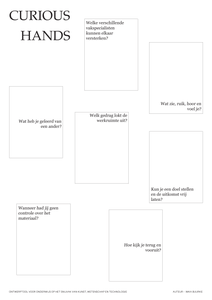
This Curious Hands Tool can be used for designing STEAM education. The design guidelines in the tool stimulate ands-on learning, the creative process and situated learning activities. The tool distinguishes between different types of STEAM education: technology-focused STEAM, problem- focused STEAM and research- focused STEAM. Depending on the type of STEAM you want to design, it offers practical design guidelines. This tool is developed and tested in various educational practices; it is part of a PhD research ‘Curious hands for E-labs’ (2019-2025).
LINK
Dit spel is tot stand gekomen in samenwerking met studenten van de master Talent Development & Creativity Rijksuniversieit Groningen (Maleah Knevel en Emma Kok), studenten van de Pabo Hanzehogeschool Groningen (Matthijs Smid, Jason Engbers, David Veen, Milan Kingma) en van Toegepaste Psychologie Hanzehogeschool Groningen (Thrisa de Vries).
MULTIFILE
Humidification is not a common procedure in many buildings in the Netherlands. An exception are buildings used for healthcare, especially hospitals. There, e.g. in operating theatres, relative humidity (RH) generally is controlled stringently at levels around 50%. From an energy point-of-view humidification is an energy-intensive activity. Currently, more than 10% of the total energy used in healthcare buildings is spent on humidification. The basis for an RH of around 50%, however, is not clear. Therefore, we pursued a scoping review to find evidence for specific RH thresholds in such facilities. In addition, an inventory was made of the current practice in the Netherlands. After analyzing the title and abstracts, the remaining references were read by two persons and scored on several topics. Guidelines and current practice were analyzed by referring to existing (inter)national guidelines and standards, and by contacting experts from Dutch hospitals through a survey and semi-structured interviews. Outcomes from the literature review were grouped into four different topics: 1) micro-organisms and viruses, 2) medical devices, 3) human physiology and 4) perception. No scientific evidence was found for the currently generally applied RH set-point of ~50%. Some studies suggest a minimum RH of 30% but the evidence is weak, with exception of medical devices if specifications require it. A lack of research that addresses more long-term exposure (a couple of days) and includes frail subjects, is noted. It was found that RH requirements are strictly followed in all hospitals consulted, some only focusing on the hot zones, but in many cases extended to the whole hospital. Steam humidification is mostly applied for hygienic reasons. but is quite energy-intensive. The conclusion t is that there is no solid evidence to support the RH-setpoints as currently applied in the Netherlands. It merely appears a code of practice. Therefore, there appears room for quick and significant energy savings, and CO2 emission reductions, when considering control at lower RH values or refraining from humidification at all, while still fulfilling the indoor environment requirements and not negatively influencing the health risk. This outcome can be applied directly in current practice with the available techniques.
LINK
The privacy discourse sputtered out of steam. This has lead to the current stalemate: we know we're observed, traced and tracked, but pretend it's not happening or nothing to fret about. The question is not when the repressed will return but how? Hackers have been proclaiming that privacy has been dead for decades, that everything can and will be captured, stored and analyzed. And they were right. So, what's to be done?
LINK
Usually the whole is the sum of its parts (added linearly): someone is happy and travelling, so happy travelling. Someone walks across a motionless and stable bridge and thus moves forward. But when hundreds of people walk together, the bridge may start to wobble quite suddenly. Both systems - the pedestrian and the bridge - are coupled into one new pattern, in which the whole is more than the sum of its parts. Such discontinuous shifts can be observed everywhere: in horses, the shift from walk to trot to canter (3 patterns); from ice to water to steam. Psychological measures - IQ, emotional stability, planning skills are marginal at best. It is argued that our behaviour is often determined by such dynamic systems.
MULTIFILE

Het lectoraat Innoverend ondernemen verbonden aan De Haagse Hogeschool heeft op 12 november 2015 een seminar georganiseerd over nieuwe businessmodellen en de nieuwe economie. Van deze dag hebben we een verslag gemaakt middels deze uitgave. Een interessant naslagwerk voor alle ruim 150 deelnemers van dit seminar, die kunnen teruglezen wat ze deze dag hebben geleerd, maar ook kunnen leren van de workshops waarin ze niet hebben geparticipeerd. Daarnaast is deze uitgave leerzaam voor iedereen die geïnteresseerd is in nieuwe businessmodellen vanuit verschillende perspectieven, waarin theorie en praktijk samen komen.
DOCUMENT

Objective: There are widespread shortages of personal protective equipment as a result of the COVID-19 pandemic. Reprocessing filtering facepiece particle (FFP)-type respirators may provide an alternative solution in keeping healthcare professionals safe. Design: Prospective, bench-to-bedside. Setting: A primary care-based study using FFP-2 respirators without exhalation valve (3M Aura 1862+ (20 samples), Maco Pharma ZZM002 (14 samples)), FFP-2 respirators with valve (3M Aura 9322+ (six samples) and San Huei 2920V (16 samples)) and valved FFP type 3 respirators (Safe Worker 1016 (10 samples)). Interventions: All masks were reprocessed using a medical autoclave (17 min at 121°C with 34 min total cycle time) and subsequently tested up to three times whether these respirators retained their integrity (seal check and pressure drop) and ability to filter small particles (0.3–5.0 µm) in the laboratory using a particle penetration test. Results: We tested 33 respirators and 66 samples for filter capacity. All FFP-2 respirators retained their shape, whereas half of the decontaminated FFP-3 respirators showed deformities and failed the seal check. The filtering capacity of the 3M Aura 1862 was best retained after one, two and three decontamination cycles (0.3 µm: 99.3%±0.3% (new) vs 97.0±1.3, 94.2±1.3% or 94.4±1.6; p<0.001). Of the other FFP-2 respirators, the San Huei 2920 V had 95.5%±0.7% at baseline vs 92.3%±1.7% vs 90.0±0.7 after one-time and two-time decontaminations, respectively (p<0.001). The tested FFP-3 respirator (Safe Worker 1016) had a filter capacity of 96.5%±0.7% at baseline and 60.3%±5.7% after one-time decontamination (p<0.001). Breathing and pressure resistance tests indicated no relevant pressure changes between respirators that were used once, twice or thrice. Conclusion: This small single-centre study shows that selected FFP-2 respirators may be reprocessed for use in primary care, as the tested masks retain their shape, ability to retain particles and breathing comfort after decontamination using a medical autoclave.
MULTIFILE

In this empirical study, the one-day project Robot Love Design-a-thon was designed for an interdisciplinary group of preservice teachers (in arts, sciences, and primary education), and evaluated through observations and learner reports. An analysis of the observations and the learner reports showed that having to go through a complete design process in a single day worked well: it facilitated the exchange of ideas and critical discussions between students concerning the project’s socially engaged theme ‘Tenderness and Technology’. In addition, interdisciplinary collaboration emerged as an important learning outcome. All students found working in mixed teams a relevant and educational experience as they could profit from each other’s expertise.
DOCUMENT

Webinar Get ready for smart technology part 1: https://youtu.be/h1HVsz2xGQs Webinar Get ready for smart technology part 2: https://youtu.be/vO11s_a8sm8 This webinar looks at both the merits, and dangers of smart technology from a psychological point of view. The combination of (smart) technology, and our non-evolved psychological basic structure, brings our entire existence and the entire planet into imbalance. Humanity is estimated to have existed for about 300,000 years. One of the most striking features is a slow propagation speed (long gestation period and usually only 1 child per litter). In addition, and unlike the other great apes, humans have little or no body hair and relatively little muscle strength. This results in a relatively small natural biotope; it should be warm enough for the "naked" monkey and there should be little or no natural predators. This is exactly why the predecessors of Homo Sapiens invented technology, with three basic techniques: 1. language (religion, signal, drawing, writing, logic, math and code) 2. lever/mechanics (spear, hammer, wheel, pulley, pistons) and 3. fire/energy (and water & steam power, magnetism , electricity, atomic power). By combining the 3 basic techniques, we have been able to colonize the whole world.
MULTIFILE




