Branden in grote gebouwen worden ontworpen: de oorzaak van brand mag dan een incident zijn, het verloop is dat nooit. We gaan ervan uit dat brand ontstaat, het is haast niet te voorkomen. Dat mag je een incident noemen. Brandontwikkeling echter is altijd voorzienbaar en voorspelbaar. Vooral brandgevolgen in grote gebouwen zijn link, die hebben de potentie voor veel slachtoffers. Maar ook de schade telt: aan gebouwen, aan milieu en leed aan vee.
MULTIFILE

Bosbranden in Portugal ontstaan door eucalyptusbomen. Die branden bij hoge temperaturen vanzelf, zo ontdekte Daan Burger, student Biotechnologie aan Van Hall Larenstein in Leeuwarden.
LINK
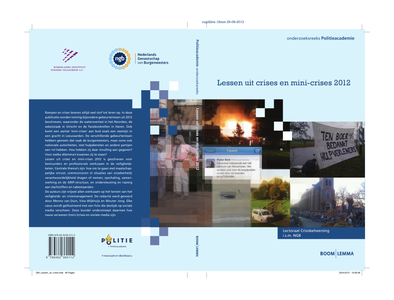
In deze publicatie staan twintig bijzondere gebeurtenissen uit 2012 centraal. Het betreffen incidenten, calamiteiten en verstoringen van de openbare orde en veiligheid. Daarmee is niet gezegd dat wij de meest kritieke momenten of crisisachtige gebeurtenissen van 2012 behandelen. Wij behandelen in dit boek een breed palet aan crisissituaties, variërend van klassieke (dreigende) ongevallen en rampen zoals wateroverlast, vervoerscalamiteiten (auto, bus, trein, schip) en aangestoken branden, tot meer afwijkende en atypische gebeurtenissen als de Facebookrellen in Haren, de asbestzaak in Utrecht en de dood van een grensrechter in Almere. Sommige van de in deze bundel opgenomen gebeurtenissen zullen de meeste lezers zich nog wel herinneren, andere gebeurtenissen zijn al weer vergeten. Mogelijk dat de foto’s en tweets bij de casus bijdragen aan de herkenning; beelden blijven immers vaak beter hangen dan woorden. Alle foto’s zijn afkomstig van tweets die ten tijde van de gebeurtenis zijn verzonden en zijn met toestemming van de makers hier opgenomen. Wij hebben er bewust voor gekozen de snelle opkomst van deze nieuwe, sociale media op deze manier te illustreren.
DOCUMENT

Inleiding in Lessen uit uit crises en mini-crises 2012. In deze publicatie staan twintig bijzondere gebeurtenissen uit 2012 centraal. Het betreffen incidenten, calamiteiten en verstoringen van de openbare orde en veiligheid. Daarmee is niet gezegd dat wij de meest kritieke momenten of crisisachtige gebeurtenissen van 2012 behandelen. Wij behandelen in dit boek een breed palet aan crisissituaties, variërend van klassieke (dreigende) ongevallen en rampen zoals wateroverlast, vervoerscalamiteiten (auto, bus, trein, schip) en aangestoken branden, tot meer afwijkende en atypische gebeurtenissen als de Facebookrellen in Haren, de asbestzaak in Utrecht en de dood van een grensrechter in Almere. Sommige van de in deze bundel opgenomen gebeurtenissen zullen de meeste lezers zich nog wel herinneren, andere gebeurtenissen zijn al weer vergeten. Mogelijk dat de foto’s en tweets bij de casus bijdragen aan de herkenning; beelden blijven immers vaak beter hangen dan woorden. Alle foto’s zijn afkomstig van tweets die ten tijde van de gebeurtenis zijn verzonden en zijn met toestemming van de makers hier opgenomen. Wij hebben er bewust voor gekozen de snelle opkomst van deze nieuwe, sociale media op deze manier te illustreren.
DOCUMENT
Aim To provide insight into the basic characteristics of decision making in the treatment of symptomatic severe aortic stenosis (SSAS) in Dutch heart centres with specific emphasis on the evaluation of frailty, cognition, nutritional status and physical functioning/functionality in (instrumental) activities of daily living [(I)ADL]. Methods A questionnaire was used that is based on the European and American guidelines for SSAS treatment. The survey was administered to physicians and non-physicians in Dutch heart centres involved in the decision-making pathway for SSAS treatment. Results All 16 Dutch heart centres participated. Before a patient case is discussed by the heart team, heart centres rarely request data from the referring hospital regarding patients’ functionality (n = 5), frailty scores (n = 0) and geriatric consultation (n = 1) as a standard procedure. Most heart centres ‘often to always’ do their own screening for frailty (n = 10), cognition/mood (n = 9), nutritional status (n = 10) and physical functioning/functionality in (I)ADL (n = 10). During heart team meetings data are ‘sometimes to regularly’ available regarding frailty (n = 5), cognition/mood (n = 11), nutritional status (n = 8) and physical functioning/functionality in (I)ADL (n = 10). After assessment in the outpatient clinic patient cases are re-discussed ‘sometimes to regularly’ in heart team meetings (n = 10). Conclusions Dutch heart centres make an effort to evaluate frailty, cognition, nutritional status and physical functioning/functionality in (I)ADL for decision making regarding SSAS treatment. However, these patient data are not routinely requested from the referring hospital and are not always available for heart team meetings. Incorporation of these important data in a structured manner early in the decision-making process may provide additional useful information for decision making in the heart team meeting.
LINK
As migrant populations age, the care system is confronted with the question how to respond to care needs of an increasingly diverse population of older adults. We used qualitative intersectional analysis to examine differential preferences and experiences with care at the end of life of twenty-five patients and their relatives from Suriname, Morocco and Turkey living in The Netherlands. Our analysis focused on the question how–in light of impairment–ethnicity, religion and gender intersect to create differences in social position that shape preferences and experiences related to three main themes: place of care at the end of life; discussing prognosis, advance care, and end-of-life care; and, end-of-life decision-making. Our findings show that belonging to an ethnic or religious minority brings forth concerns about responsive care. In the nursing home, patients’ minority position and the interplay thereof with gender make it difficult for female patients to request and receive responsive care. Patients with a strong religious affiliation prefer to discuss diagnosis but not prognosis. These preferences are at interplay with factors related to socioeconomic status. The oversight of this variance hampers responsive care for patients and relatives. Preferences for discussion of medical aspects of care are subject to functional impairment and faith. Personal values and goals often remain unexpressed. Lastly, preferences regarding medical end-of-life decisions are foremost subject to religious affiliation and associated moral values. Respondents’ impairment and limited Dutch language proficiency requires their children to be involved in decision-making. Intersecting gendered care roles determine that mostly daughters are involved. Considering the interplay of aspects of social identity and their effect on social positioning, and pro-active enquiry into values, goals and preferences for end-of-life care of patients and their relatives are paramount to achieve person centred and family-oriented care responsive to the needs of diverse communities.
DOCUMENT

With an increasingly ageing population there will be a rising demand for palliative care, including from older migrants and ethnic minorities. While many (future) physicians are unfamiliar with specific needs of older migrants and ethnic minorities regarding care and communication in palliative care, this may be challenging for them to deal with. Moreover, even many medical teachers also feel unprepared to teach palliative care and culturally sensitive communication to students. In order to support medical teachers, we suggest twelve tips to teach culturally sensitive palliative care to guide the development and implementation of teaching this topic to medical students. Drawn from literature and our own experiences as teachers, these twelve tips provide practical guidance to both teachers and curriculum designers when designing and implementing education about culturally sensitive palliative care.
MULTIFILE

Jan Van der Noot (c.1540-c.1601) is a central figure in Dutch literature, widely regarded as the first true Renaissance poet in the Netherlands. He was the earliest Dutch poet to imitate Ronsard, Baïf, and Petrarch, and the first to use the sonnetform. Van der Noot also has vital links with sixteenth-century England and English literature. While living in London (1567-72), he produced the source-text for Spenser and Roest's Theatre of Voluptuous Worldlings. Yet despite this contribution, he is frequently overlooked by English-speaking critics. Even when he does receive consideration, he is seldom viewed as a poet in his own right. As an attempt to redress this, we offer here fresh translations from Van der Noot's work, lightly annotated throughout, concentrating on the sonnets that are the lynchpin of his reputation.
DOCUMENT

Als lector en als voorzitter van LEV ben ik dagelijks met veiligheid bezig. Hoe we daaraan werken en hoe we daarbij ook omgaan met burgers...het blijft me steeds weer boeien. En verbazen. Meestal gun ik mezelf de tijd niet mijn gedachten vast te leggen. Soms wel. Dan vindt u ze hier. Geschreven op persoonlijke titel. Deze column verscheen eerder in de rubriek Opinie van de Volkskrant (maandag 23 juni).
LINK
In recent onderzoek is gevonden dat een goede werkalliantie voortijdig uitval van cliënten kan voorkomen. Reden genoeg om na te gaan hoe de bespreking van de werkalliantie tussen professionals en cliënten kan worden verbeterd. Daarvoor moesten we eerst weten hoe professionals en cliënten zo’n bespreking ervaren: vinden zij het zinvol, levert het iets op, denken zij dat het de samenwerking ten goede komt? Want alleen als zij het beiden zinvol vinden, kan het een positieve invloed hebben op de kwaliteit van de werkalliantie later in het traject. In de periode 2016-2018 deed de HU onderzoek naar hoe sociale professionals, werkzaam in de werkvelden reclassering, jeugdbescherming, schuldhulpverlening, arbeidsintegratie en maatschappelijke opvang, denken over het begrip werkalliantie in het gedwongen kader, hoe zij de kenmerken daarvan bepreken met cliënten, en hoe dit bij hun cliënten uitwerkt. Ook is nagegaan of professionals en cliënten de zg. ‘werkalliantiemonitor’ een zinvol hulpmiddel vinden bij het bespreekbaar maken van de werkalliantie.
MULTIFILE




