During the medieval and early modern periods, the mock sermon was one of the most widely staged festive rituals. There are records of its performance in most European countries and cultures. But despite its clear popularity in England, few of these texts are extant in English. Fewer still have been translated in their entirety. To remedy this situation, we provide here a translation of the sixteenth century Dutch poem Spotsermoen over Sint Niemand. This piece embodies most of the key features of the mock sermon; the text's rhetorical strategies, its content, and the details it reveals about its performance are all typical of the genre. Thus, the poem is offered as a specimen of the mock sermon's overall conventions and forms.
DOCUMENT

De Dinkel is een unieke beek die al door Twente stroomt sinds de laatste ijstijd. In de tussentijd is er ontzettend veel veranderd, grotendeels door de mens. Die sporen zijn nog terug te vinden in de beekoever. Historisch landschapsecoloog Harm Smeenge, werkzaam bij Bosgroepen, promoveerde op het landschap van Noordoost-Twente en ontdekte een belangrijke snelweg recht door het water.
LINK
Hoe dichters dichten sullen ende wat sie hantieren sullen (ca. 1330) van Jan van Boendale leent zich bij uitstek om scholieren een literair-wetenschappelijk onderzoekje te laten doen. In deze tekst legt Boendale uit waaraan een goed verhaal en een goede schrijver moeten voldoen. Zijn puntsgewijze uitleg zorgt voor een helder en begrijpelijk betoog. Hiermee kan de leerling zelfstandig aan de slag met een middeleeuws literair boek: hoeveel 'Boendale-aspecten' vind je terug in de door jou gekozen tekst? Hoe meer aspecten je ziet, hoe beter het verhaal past binnen de middeleeuwse poëtica, hoe mooier de middeleeuwers het verhaal gevonden hebben.
DOCUMENT

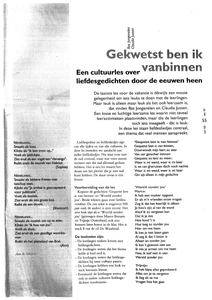
De laatste les voor de vakantie is dikwijls een mooie gelegenheid om iets leuks te doen met de leerlingen. Maar leuk is alleen maar leuk als het ook leerzaam is, dat vinden Bas Jongenelen en Claudia Jussen. Een losse en luchtige leerzame les waarin niet teveel leeractiviteiten plaatsvinden, maar die de leerlingen toch iets meegeeft - dat is leuk. In deze les staan liefdesliedjes centraal, een thema dat veel mensen aanspreekt.
DOCUMENT
Recensie van Jan Bloemendal, Arjan van Dixhoorn & Elsa Strietman (ed.), Literary Cultures and Public Opinion in the Low Countries 1450-1650.
DOCUMENT

Op het blog Neder-L schrijf ik wekelijks een bericht. Meestal gaat het over Middeleeuwse literatuur, maar het zou ook over het eindexamen Nederlands kunnen gaan.
DOCUMENT
This article offers the first substantial survey of the Middle Dutch satire Dit es de Frenesie since the work of C.P. Serrure in the mid nineteenth century. It contests much of the conventional wisdom surrounding De Frenesie, challenging the poem's usual classification as an early boerde or fabliau. Instead it is argued that the text is an experimental work, which blends together elements of several satiric traditions without committing itself to any one. The implications of this maneuver and others within the text are considered, revealing the poem's clear sympathy with the newly educated and articulate laity. De Frenesie itself is appended in both the original Middle Dutch and an English verse translation.
DOCUMENT

In c.1330 the Antwerp public servant Jan van Boendale composed Der Leken Spieghel (The Layman's Mirror), a free adaption of several earlier Latin treatises on education. Van Boendale evidently wanted to ensure that a clear and reliable handbook was available to the laity, who lacked sufficient training in Latin to access the original texts. Der Leken Spieghel consists of four books, each divided into numerous smaller sections. This article presents a fresh translation of paragraph 113, which outlines the four characteristics needed to conduct an honourable life.
DOCUMENT

Abstract Chapter 4: Basing ourselves on a literature review and expert interviews we create an overview of methods and tools to identify and respond to ethical questions used in healthcare, social work, police and the military. We identify six main types of methods or tools that can support professionals or organisations in dealing with ethical issues. Some of these methods are already used in CT or could be used. Some methods or tools are targeted at individual professionals or small groups, whilst others are targeted at the organisational level. The methods and tools are described in brief. Samenvatting boek: Wat is ethisch wel en wat niet geoorloofd? De aanslagen die de Europese hoofdsteden teisteren wrijven het ons in: terrorismebestrijding is noodzakelijk en is onlosmakelijk verbonden met de moderne samenleving. De inlichtingendiensten en andere organisaties die zich hiermee bezighouden, stuiten echter telkens op de vraag hoe ver zij mogen gaan. Waar liggen de grenzen? Wat is ethisch wel en wat niet geoorloofd? En vooral: hoe gaan professionals met deze soms levensgrote dilemma's om? In deze Engelstalige uitgave reflecteren wetenschappers, terrorismebestrijders en ethici op dit zeer actuele thema.
MULTIFILE
In dit artikel vertalen de auteurs vier liedjes uit het Antwerps Liedboek (1544) in rijmend hedendaags Engels.
DOCUMENT




