This study examines the relationships between students’ perceptions of heavy study load, time spent on learning, study strategies, and learning outcomes. Student’s study strategies were measured with a short version of Vermunt’s Inventory of Learning Styles. It was possible to replicate 5 processing and 5 regulation strategies. The higher order dimensions meaning directed learning style (relate and structure, concrete processing, critical processing) and reproduction directed learning style (memorize and repeat, analyze, self-regulation of contents, process and results, external regulation of the learning process) differed from Vermunt. The scales showed differences across groups, which is in line with previous research. Linear structural analysis showed that reproduction directed learning precedes meaning directed learning. Only meaning directed learning affected GPA, the influence of the two learning styles on ECs was not evidenced in this study. Contact hours influenced ECs, but this effect was tempered through its negative association with a heavy study load. The limitations, implications for practice, and directions for further research and development will be discussed in the round table.
DOCUMENT

Background: A quality improvement collaborative is an intensive project involving a combination of implementation strategies applied in a limited “breakthrough” time window. After an implementation project, it is generally difficult to sustain its success. In the current study, sustainability was described as maintaining an implemented innovation and its benefits over a longer period of time after the implementation project has ended. The aim of the study was to explore potentially promising strategies for sustaining the Enhanced Recovery After Surgery (ERAS) programme in colonic surgery as perceived by professionals, three to six years after the hospital had successfully finished a quality improvement collaborative. Methods: A qualitative case study was performed to identify promising strategies to sustain key outcome variables related to the ERAS programme in terms of adherence, time needed for functional recovery and hospital length of stay (LOS), as achieved immediately after implementation. Ten hospitals were selected which had successfully implemented the ERAS programme in colonic surgery (2006–2009), with success defined as a median LOS of 6 days or less and protocol adherence rates above 70%. Fourteen semi-structured interviews were held with eighteen key participants of the care process three to six years after implementation, starting with the project leader in every hospital. The interviews started by confronting them with the level of sustained implementation results. A direct content analysis with an inductive coding approach was used to identify promising strategies. The mean duration of the interviews was 37 minutes (min 26 minutes – max 51 minutes). Results: The current study revealed strategies targeting professionals and the organisation. They comprised internal audit and feedback on outcomes, small-scale educational booster meetings, reminders, changing the physical structure of the organisation, changing the care process, making work agreements and delegating responsibility, and involving a coordinator. A multifaceted self-driven promising strategy was applied in most hospitals, and in most hospitals promising strategies were suggested to sustain the ERAS programme. Conclusions: Joining a quality improvement collaborative may not be enough to achieve long-term normalisation of transformed care, and additional investments may be needed. The findings suggest that certain post-implementation strategies are valuable in sustaining implementation successes achieved after joining a quality improvement collaborative.
DOCUMENT

Purpose Supervisors are responsible to train students in healthcare placements. Although there is knowledge about workplace learning and supervision in general, little is known about supervisors’ pedagogic strategies in specific healthcare placements. In this study, we identify how supervisors’ reasoning and interrelated actions manifest in physiotherapy and nursing work settings. Methods Following the stimulating recall approach, we conducted 16 interviews with supervisors at seven work settings. Using a theoretical framework of workplace supervision, we performed a deductive template analysis. Results Four configurations of pedagogic strategies reveal how supervision manifests in healthcare placements. The results provide unique insights into specific supervision moments, and elucidate the situatedness of the supervisors’ strategies. Conclusions The present study illustrates the variation in aims and focus of supervisors in placements. Supervisors’ pedagogic strategies were found to be mainly based on (A) role modelling, (B) overall support, (C) trust, and (D) letting go. Further research is needed to investigate the interplay between supervisors and students in learning situations within work settings.
LINK
Many students persistently misinterpret histograms. This calls for closer inspection of students’ strategies when interpreting histograms and case-value plots (which look similar but are diferent). Using students’ gaze data, we ask: How and how well do upper secondary pre-university school students estimate and compare arithmetic means of histograms and case-value plots? We designed four item types: two requiring mean estimation and two requiring means comparison. Analysis of gaze data of 50 students (15–19 years old) solving these items was triangulated with data from cued recall. We found five strategies. Two hypothesized most common strategies for estimating means were confirmed: a strategy associated with horizontal gazes and a strategy associated with vertical gazes. A third, new, count-and-compute strategy was found. Two more strategies emerged for comparing means that take specific features of the distribution into account. In about half of the histogram tasks, students used correct strategies. Surprisingly, when comparing two case-value plots, some students used distribution features that are only relevant for histograms, such as symmetry. As several incorrect strategies related to how and where the data and the distribution of these data are depicted in histograms, future interventions should aim at supporting students in understanding these concepts in histograms. A methodological advantage of eye-tracking data collection is that it reveals more details about students’ problem-solving processes than thinking-aloud protocols. We speculate that spatial gaze data can be re-used to substantiate ideas about the sensorimotor origin of learning mathematics.
LINK
Objectives: Promoting unstructured outside play is a promising vehicle to increase children’s physical activity (PA). This study investigates if factors of the social environment moderate the relationship between the perceived physical environment and outside play. Study design: 1875 parents from the KOALA Birth Cohort Study reported on their child’s outside play around age five years, and 1516 parents around age seven years. Linear mixed model analyses were performed to evaluate (moderating) relationships among factors of the social environment (parenting influences and social capital), the perceived physical environment, and outside play at age five and seven. Season was entered as a random factor in these analyses. Results: Accessibility of PA facilities, positive parental attitude towards PA and social capital were associated with more outside play, while parental concern and restriction of screen time were related with less outside play. We found two significant interactions; both involving parent perceived responsibility towards child PA participation. Conclusion: Although we found a limited number of interactions, this study demonstrated that the impact of the perceived physical environment may differ across levels of parent responsibility.
MULTIFILE

Introduction: Fall rates and fall-related injuries among community-dwelling older adults (≥65 years) are expected to increase rapidly, due to the aging population worldwide. Fall prevention programs (FPPs), consisting of strength and balance exercises, have been proven effective in reducing fall rates among older adults. However, these FPPs have not reached their full potential as most programs are under-enrolled. Therefore, this study aims to identify promising strategies that promote participation in FPPs among community-dwelling older adults. Methods: This is an exploratory qualitative study. Previously, barriers and facilitators for participation in FPPs by older adults had been identified. Next, six strategies had been designed using the Intervention Mapping approach: (1) reframing; (2) informing about benefits; (3) raising awareness of risks; (4) involving social environment; (5) offering tailored intervention; (6) arranging practicalities. Strategies were validated during semi-structured interviews with communitydwelling older adults (n = 12) at risk of falling. Interviews were audio-recorded, transcribed, and analyzed following a qualitative thematic methodology, with a hybrid approach. Results: All strategies were considered important by at least some of the respondents. However, two strategies stood out: (1) reframing ‘aging’ and ‘fall prevention’: respondents preferred to be approached differently, taking a ‘life course’ perspective about falls, and avoiding confronting words; and (2) ‘informing about benefits’ (e.g., ‘living independently for longer’); which was mentioned to improve the understanding of the relevance of participating in FPPs. Other strategies were considered important to take into account too, but opinions varied more strongly. Discussion: This study provides insight into potential strategies to stimulate older adults to participate in FPPs. Results suggest that reframing ‘aging’ and ‘fall prevention’ may facilitate the dialogue about fall prevention, by communicating differently about the topic, for example ‘staying fit and healthy’, while focusing on the benefits of participating in FPPs. Gaining insight into the strategies’ effectiveness and working mechanisms is an area for future research. This could lead to practical recommendations and help professionals to enhance older adults’ participation in FPPs. Currently, the strategies are further developed to be applied and evaluated for effectiveness in multiple field labs in a central Dutch region (Utrecht).
DOCUMENT

BACKGROUND: Family members of patients treated with Extracorporeal Membrane Oxygenation (ECMO) during an Intensive Care Unit (ICU) stay are at risk of developing symptoms of anxiety, depression and Post-Traumatic Stress Disorder (PTSD). Coping strategies used by family members may play an important role in the severity of some of these symptoms.OBJECTIVES: The primary aim of this study was to describe coping strategies used by family members of ECMO-treated patients during ICU admission and recovery period. The secondary aim was to explore the course of the symptoms anxiety, depression, PTSD, and Health Related Quality Of Life (HRQOL) over time.METHODS: In this single-center prospective longitudinal study, validated questionnaires were used to measure coping strategies, symptoms of anxiety, depression and PTSD, and HRQOL in family members of ECMO-treated patients directly after the start of ECMO and at one and six months after the start of ECMO.RESULTS: Family members (n = 26) mainly used problem-focused coping strategies. Symptoms of anxiety appeared to be most present during treatment but decreased over time, as did symptoms of depression and PTSD. HRQOL was severely affected, especially in the mental domain, and did not improve over time.CONCLUSION: In family members of ECMO-treated patients, problem-focused coping mechanisms were most prominent. Psychological functioning was impaired on admission but improved over time, although a mild reaction to stress remained.
DOCUMENT
Objectives: Emotional eating is recognized as a potential contributor to weight gain. Emotional eaters often hide their problems because of feelings of shame about their behavior, making it challenging to provide them with the necessary support. The introduction of a virtual coach might offer a potential solution in assisting them. To find out whether emotional eaters are receptive to online personalized coaching, we presented emotional eaters with two essential proto-typical problem situations for emotional eaters: “experiencing cravings” and “after giving in to cravings,” and asked them whether they preferred one of the three coaching strategies presented: Validating, Focus-on-Change and Dialectical.Methods: An experimental vignette study (2 × 3 design) was carried out. The vignettes featured two distinct personas, each representing one of the two common problem scenarios experienced by emotional eaters, along with three distinct coaching strategies for each scenario. To identify potential predictors for recognition of problem situations, questionnaires on emotional eating (DEBQ), personality traits (Big-5), well-being (PANAS), and BMI were administrated.Results: A total of 62% of the respondents identified themselves with “after giving in to cravings” and 47% with “experiencing cravings.” BMI, emotional eating and emotional stability appeared to be predictors in recognizing both the problem situations. In “experiencing cravings,” the participating women preferred Dialectical and the Validation coaching strategies. In the “after giving in to cravings” condition, they revealed a preference for the Dialectical and the Focus-on-Change coaching strategies.Conclusion: Using vignettes allowed a less threatening way of bringing up sensitive topics for emotional eaters. The personas representing the problem situations were reasonably well recognized. To further enhance this recognition, it is important for the design and content of the personas to be even more closely related to the typical problem scenarios of emotional eaters, rather than focusing on physical characteristics or social backgrounds. This way, users may be less distracted by these factors. With the knowledge gained about the predictors that may influence recognition of the problem situations, design for coaching can be more customized. The participants represented individuals with high emotional eating levels, enhancing external validity.
DOCUMENT
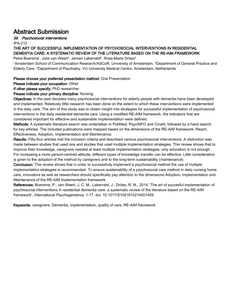
Presentatie gegeven over de review in Brussel Objectives: In the past decades many psychosocial interventions for elderly people with dementia have been developed and implemented. Relatively little research has been done on the extent to which these interventions were implemented in the daily care. The aim of this study was to obtain insight into strategies for successful implementation of psychosocial interventions in the daily residential dementia care. Using a modified RE-AIM framework, the indicators that are considered important for effective and sustainable implementation were defined.
MULTIFILE
Blended learning offers a learner-centred approach that employs both in-class learning and digital technology to facilitate online learning. Such an approach is especially advantageous to adult-learners in higher education as it meets their educational needs. However, adult-learners’ participation in blended learning programmes remains challenging due to a general lack of online interaction, and no clear teaching strategies that address this concern. Literature relating to adult-learners’ educational needs and online interaction was consulted in order to design teaching strategies that foster adult-learners’ online interaction. The aim of this study is to further validate these teaching strategies, hence a multiple case study was carried out using a mixed method approach. As such, eight teachers and sixteen students from four courses across three universities in Belgium and the Netherlands were interviewed. Additionally, a questionnaire testing a pre-defined set of variables was distributed to 84 students. The results lead to a set of validated teaching strategies that help teachers to further develop their professional skills and expertise. The teaching strategies can be grouped into three categories, namely 1) the teacher's online presence, 2) collaborative learning activities and preparatory learning activities, and 3) the distribution of learning content and learning activities across online and in-class learning. An elaborate set of validated teaching strategies is included. This study aids towards teacher professional development and adds evidence-based knowledge to teaching strategies and instructional frameworks for adult-learners in higher education.
LINK



