Over the last two decades, institutions for higher education such as universities and colleges have rapidly expanded and as a result have experienced profound changes in processes of research and organization. However, the rapid expansion and change has fuelled concerns about issues such as educators' technology professional development. Despite the educational value of emerging technologies in schools, the introduction has not yet enjoyed much success. Effective use of information and communication technologies requires a substantial change in pedagogical practice. Traditional training and learning approaches cannot cope with the rising demand on educators to make use of innovative technologies in their teaching. As a result, educational institutions as well as the public are more and more aware of the need for adequate technology professional development. The focus of this paper is to look at action research as a qualitative research methodology for studying technology professional development in HE in order to improve teaching and learning with ICTs at the tertiary level. The data discussed in this paper have been drawn from a cross institutional setting at Fontys University of Applied Sciences, The Netherlands. The data were collected and analysed according to a qualitative approach.
DOCUMENT

In the following paper I investigate several factors of integration and their influence on students’ success in higher education derived from leading pedagogical theories. Furthermore the use of Facebook by first year students, in the Department of Media, Communication and Information at the Amsterdam University of Applied Sciences is discussed as a possible new influential factor of student success in contemporary society. The differences in the purpose of Facebook use by students are measured and compared with factors of integration, which were proven in previous studies, to be of influence to the success of students in higher education. Because this study is part of a broader (PhD) research wherein I investigate the influence of media literacy and its possible effect on students’ success, I will embed the results in a more theoretical discussion into integration in higher education and compare the results with previous studies conducted among the same population as part of previous mentioned research. All variables are measured using digital surveys and analysed with the help of statistical tests. This paper will ultimately investigate the relation between the variables derived from Tinto’s integration theory in contemporary society, Facebook use by students and its possible influence on students’ success.
LINK
The COVID-19 pandemic has forced higher education (HE) to shift to emergency remote teaching (ERT), subsequently influencing academic belonging and social integration, as well as challenging students' engagement with their studies. This study investigated influences on student engagement during ERT, based on student resilience. Serial mediation analyses were used to test the predictive effects between resilience, academic belonging, social integration, and engagement.
MULTIFILE

Integrated curricula seem promising for the increase of attention on science and technology in primary education. A clear picture of the advantages and disadvantages of integration efforts could help curriculum innovation. This review has focussed on integrated curricula in primary education from 1994 to 2011. The integrated curricula were categorized according to a taxonomy of integration types synthesized from the literature. The characteristics that we deemed important were related to learning outcomes and success/fail factors. A focus group was formed to facilitate the process of analysis and to test tentative conclusions. We concluded that the levels in our taxonomy were linked to (a) student knowledge and skills, the enthusiasm generated among students and teachers, and the teacher commitment that was generated; and (b) the teacher commitment needed, the duration of the innovation effort, the volume and comprehensiveness of required teacher professional development, the necessary teacher support, and the effort needed to overcome tensions with standard curricula. Almost all projects were effective in increasing the time spent on science at school. Our model resolves Czerniac’s definition problem of integrating curricula in a productive manner, and it forms a practical basis for decision-making by making clear what is needed and what output can be expected when plans are being formulated to implement integrated education.
DOCUMENT

Advanced technology is a primary solution for the shortage of care professionals and increasing demand for care, and thus acceptance of such technology is paramount. This study investigates factors that increase use of advanced technology during elderly care, focusing on current use of advanced technology, factors that influence its use, and care professionals’ experiences with the use. This study uses a mixed-method design. Logfiles were used (longitudinal design) to determine current use of advanced technology, questionnaires assessed which factors increase such use, and in-depth interviews were administered to retrieve care professionals’ experiences. Findings suggest that 73% of care professionals use advanced technology, such as camera monitoring, and consult clients’ records electronically. Six of nine hypotheses tested in this study were supported, with correlations strongest between performance expectancy and attitudes toward use, attitudes toward use and satisfaction, and effort expectancy and performance expectancy. Suggested improvements for advanced technology include expanding client information, adding report functionality, solving log-in problems, and increasing speed. Moreover, the quickest way to increase acceptance is by improving performance expectancy. Care professionals scored performance expectancy of advanced technology lowest, though it had the strongest effect on attitudes toward the technology.
DOCUMENT

There are different strategies of curriculum implementation regarding ICT education in schools of social work. It concentrates on ICT as a content of social work education, not on educational technology. Theoretically, an integral approach of ICT teaching ( social informatics ) is considered an adequate strategy for an up to date social work education. In practice however, the institutes of vocational education do not arrive at a full integration of social informatics. Some conditions are discussed that support integration as an implementation strategy.
DOCUMENT

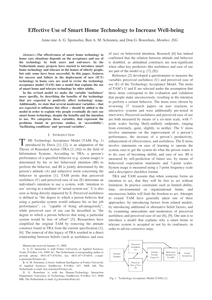
The effectiveness of smart home technology in home care situations depends on the acceptance and use of the technology by both users and end-users. In the Netherlands many projects have started to introduce smart home technology and telecare in the homes of elderly people, but only some have been successful. In this paper, features for success and failure in the deployment of new (ICT) technology in home care are used to revise the technology acceptance model (TAM) into a model that explains the use of smart home and telecare technology by older adults. In the revised model we make the variable 'usefulness' more specific, by describing the benefits of the technology that are expected to positively affect technology usage. Additionally, we state that several moderator variables - that are expected to influence this effect - should be added to the model in order to explain why people eventually do (not) use smart home technology, despite the benefits and the intention to use. We categorize these variables, that represent the problems found in previous studies, in 'accessibility', 'facilitating conditions' and 'personal variables'.
DOCUMENT
From the article: "Abstract, technology-enhanced learning can be used to replicate existing teaching practices, supplement existing teaching or transform teaching and/or learning process and outcomes. Enhancing workplace learning, which is integrated into higher professional education, with technology, calls for designing such transformations. Although research is carried out into different kinds of technological solutions to enhance workplace learning, we do not know which principles should guide such designs. Therefore, we carried out an explorative, qualitative study and found two such design principles for the design of technology-enhanced workplace learning in higher professional education. In this research, we focused on the students' perspective, since they are the main users of such technology when they are learning at the workplace, as part of their study in becoming lifelong learning, competent professionals."
DOCUMENT
Expectations are high with regards to smart home technology. In particular, smart home technology is expected to support or enable independent living by older adults. This raises the question: can smart home technology contribute to independent living, according to older adults themselves? This chapter aims to answer this question by reviewing and discussing older adults’ perspectives on independence and their views on smart home technology. Firstly, older adults’ opinions on independence and aging in place are discussed. Secondly, this chapter will review to what extent smart home technology can support older adults’ independence. Thirdly, it will be explained how community-dwelling older adults’ concept of independence entails three distinct types or modes, and how these modes are related to their perceptions and acceptance of technology. In the last section of this chapter, an overview of key points is presented, and recommendations for technology designers, policy makers, and care providers are postulated.
LINK
Transitions in health care and the increasing pace at which technological innovations emerge, have led to new professional approach at the crossroads of health care and technology. In order to adequately deal with these transition processes and challenges before future professionals access the labour market, Fontys University of Applied Sciences is in a transition to combining education with interdisciplinary practice-based research. Fontys UAS is launching a new centre of expertise in Health Care and Technology, which is a new approach compared to existing educational structures. The new centre is presented as an example of how new initiatives in the field of education and research at the intersection of care and technology can be shaped.
DOCUMENT