Lichamelijke zwakte is een belangrijk onderdeel van kwetsbaarheid en komt veel voor bij oudere volwassenen. Terwijl vrouwen een hogere prevalentie en een eerder begin van kwetsbaarheid kennen zijn sekseverschillen in de ontwikkeling van lichamelijke zwakte nauwelijks bestudeerd. Daarom hebben we in spieren de veranderingen onderzocht die onderscheid maken tussen fitte en zwakke ouderen voor elk geslacht afzonderlijk. Mannen (n = 28) en vrouwen (n = 26) van 75 jaar en ouder werden gegroepeerd op basis van hun fysieke prestatiecriteria. Er werd gebruik gemaakt van spierbiopten genomen uit de vastus lateralis-spier voor genexpressie- en histologisch onderzoek. Er werden paarsgewijze vergelijkingen gemaakt tussen de sterkste en de zwakste groepen voor elk geslacht afzonderlijk, en potentiële geslachts-specifieke effecten werden beoordeeld. Zwakke vrouwen toonden een hogere expressie van ontstekingsroutes, infiltratie van NOX2-immuuncellen, samen met een hogere VCAM1-expressie. Zwakke mannen werden gekenmerkt door een kleinere diameter van type 2 (snelle) spiervezels en lagere expressie van PRKN. Zwakte-geassocieerde genexpressie-veranderingen in de spieren waren verschillend van veroudering-geassocieerde genexpressie-veranderingen, wat erop wijst dat de pathofysiologie van fysieke zwakte niet noodzakelijkerwijs afhankelijk is van veroudering. We concluderen dat zwakte-geassocieerde veranderingen in de spieren sekse-specifiek zijn. Aanbevolen wordt om bij onderzoek naar kwetsbaarheid rekening te houden met sekseverschillen, omdat deze verschillen een grote impact kunnen hebben over de ontwikkeling van (farmaceutische) interventies tegen kwetsbaarheid.
MULTIFILE

Synthetic glucocorticoids are potent anti-inflammatory drugs but show dose-dependent metabolic side effects such as the development of insulin resistance and obesity. The precise mechanisms involved in these glucocorticoid-induced side effects, and especially the participation of adipose tissue in this are not completely understood. We used a combination of transcriptomics, antibody arrays and bioinformatics approaches to characterize prednisolone-induced alterations in gene expression and adipokine secretion, which could underlie metabolic dysfunction in 3T3-L1 adipocytes. Several pathways, including cytokine signalling, Akt signalling, and Wnt signalling were found to be regulated at multiple levels, showing that these processes are targeted by prednisolone. These results suggest that mechanisms by which prednisolone induce insulin resistance include dysregulation of wnt signalling and immune response processes. These pathways may provide interesting targets for the development of improved glucocorticoids.
DOCUMENT
Pseudomonas fluorescens strain SS101 (Pf.SS101) promotes growth of Arabidopsis thaliana, enhances greening and lateral root formation, and induces systemic resistance (ISR) against the bacterial pathogen Pseudomonas syringae pv. tomato (Pst). Here, targeted and untargeted approaches were adopted to identify bacterial determinants and underlying mechanisms involved in plant growth promotion and ISR by Pf.SS101. Based on targeted analyses, no evidence was found for volatiles, lipopeptides and siderophores in plant growth promotion by Pf.SS101. Untargeted, genome‐wide analyses of 7488 random transposon mutants of Pf.SS101 led to the identification of 21 mutants defective in both plant growth promotion and ISR. Many of these mutants, however, were auxotrophic and impaired in root colonization. Genetic analysis of three mutants followed by site‐directed mutagenesis, genetic complementation and plant bioassays revealed the involvement of the phosphogluconate dehydratase gene edd, the response regulator gene colR and the adenylsulfate reductase gene cysH in both plant growth promotion and ISR. Subsequent comparative plant transcriptomics analyses strongly suggest that modulation of sulfur assimilation, auxin biosynthesis and transport, steroid biosynthesis and carbohydrate metabolism in Arabidopsis are key mechanisms linked to growth promotion and ISR by Pf.SS101.
LINK
Despite changing attitudes towards animal testing and current legislation to protect experimental animals, the rate of animal experiments seems to have changed little in recent years. On May 15–16, 2013, the In Vitro Testing Industrial Platform (IVTIP) held an open meeting to discuss the state of the art in alternative methods, how companies have, can, and will need to adapt and what drives and hinders regulatory acceptance and use. Several key messages arose from the meeting. First, industry and regulatory bodies should not wait for complete suites of alternative tests to become available, but should begin working with methods available right now (e.g., mining of existing animal data to direct future studies, implementation of alternative tests wherever scientifically valid rather than continuing to rely on animal tests) in non-animal and animal integrated strategies to reduce the numbers of animals tested. Sharing of information (communication), harmonization and standardization (coordination), commitment and collaboration are all required to improve the quality and speed of validation, acceptance, and implementation of tests. Finally, we consider how alternative methods can be used in research and development before formal implementation in regulations. Here we present the conclusions on what can be done already and suggest some solutions and strategies for the future.
DOCUMENT

Both because of the shortcomings of existing risk assessment methodologies, as well as newly available tools to predict hazard and risk with machine learning approaches, there has been an emerging emphasis on probabilistic risk assessment. Increasingly sophisticated AI models can be applied to a plethora of exposure and hazard data to obtain not only predictions for particular endpoints but also to estimate the uncertainty of the risk assessment outcome. This provides the basis for a shift from deterministic to more probabilistic approaches but comes at the cost of an increased complexity of the process as it requires more resources and human expertise. There are still challenges to overcome before a probabilistic paradigm is fully embraced by regulators. Based on an earlier white paper (Maertens et al., 2022), a workshop discussed the prospects, challenges and path forward for implementing such AI-based probabilistic hazard assessment. Moving forward, we will see the transition from categorized into probabilistic and dose-dependent hazard outcomes, the application of internal thresholds of toxicological concern for data-poor substances, the acknowledgement of user-friendly open-source software, a rise in the expertise of toxicologists required to understand and interpret artificial intelligence models, and the honest communication of uncertainty in risk assessment to the public.
DOCUMENT

The evolution of emerging technologies that use Radio Frequency Electromagnetic Field (RF-EMF) has increased the interest of the scientific community and society regarding the possible adverse effects on human health and the environment. This article provides NextGEM’s vision to assure safety for EU citizens when employing existing and future EMF-based telecommunication technologies. This is accomplished by generating relevant knowledge that ascertains appropriate prevention and control/actuation actions regarding RF-EMF exposure in residential, public, and occupational settings. Fulfilling this vision, NextGEM commits to the need for a healthy living and working environment under safe RF-EMF exposure conditions that can be trusted by people and be in line with the regulations and laws developed by public authorities. NextGEM provides a framework for generating health-relevant scientific knowledge and data on new scenarios of exposure to RF-EMF in multiple frequency bands and developing and validating tools for evidence-based risk assessment. Finally, NextGEM’s Innovation and Knowledge Hub (NIKH) will offer a standardized way for European regulatory authorities and the scientific community to store and assess project outcomes and provide access to findable, accessible, interoperable, and reusable (FAIR) data.
DOCUMENT

Om inzicht te krijgen in spierveroudering is genexpressie gemeten in vastus lateralis biopten van jonge en oude mannen en vrouwen. We vonden dat tijdens het ouder worden bij beide geslachten dezelfde categorieën genen in spieren worden aan- en uitgeschakeld (“gereguleerd”); de mate van deze zogenaamde differentiële expressie was echter geslachtsspecifiek. Bij mannen was oxidatieve fosforylering het meest in het oog springende proces, en bij vrouwen was dit celgroei gemedieerd door AKT-signalering. De conclusie is dat dezelfde processen zijn geassocieerd met skeletspierveroudering bij mannen en vrouwen, maar dat de differentiële expressie van die processen geslachtsspecifiek is.
MULTIFILE

Peerreview is een leeractiviteit waarbij studenten elkaar feedback geven. Uit onderzoek blijkt dat peerreview een leerproces effectief kan ondersteunen, maar alleen als het goed wordt georganiseerd. De onderzoekslijn Teaching, Learning & Technology doet daarom onderzoek naar de effectieve inzet van peerreview in leerprocessen. In deze factsheet gaan we in op het organiseren van peerreview. Dit wordt ook wel scripting van peerreview genoemd. Ons onderzoek heeft een script met zeven stappen opgeleverd. In deze factsheet worden de stappen beschreven. Daarbij wordt per stap aangeven wie wat doet op welke manier, en waar dat plaatsvindt.
DOCUMENT

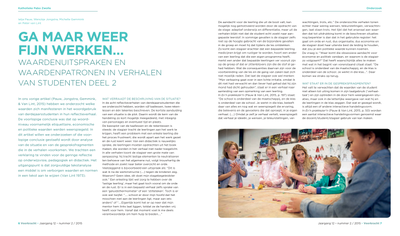
Tweede deel van een artikel over welke waarden zich manifesteren in het woordgebruik van derdejaarsstudenten in hun reflectieverhaal. Uit dit deel van het onderzoek is gebleken dat studenten hun professionele identiteit ook in het derde jaar nog voornamelijk framen in het kader van organisatorische en hiërarchische waarden en slechts beschikken over een beperkt aantal scripts voor hun handelen.
DOCUMENT
De opleiding Business studies (BBS) organiseert het afstudeerproces via afstudeerkringen. De opleiding ervaart problemen bij het op gang brengen en productief maken van het samenwerkend leren tijdens de kringbijeenkomsten en daarbuiten. Daarnaast liggen er vraagstukken rondom het effectief inzetten van technologie om het samenwerkend leren binnen en buiten de kringbijeenkomsten te ondersteunen. Doel van dit onderzoek is het ontwerpen en testen van een (prototype)script van een effectieve inzet van samenwerkend leren binnen de met technologie ondersteunde afstudeerkringen. In dit rapport komen het vooronderzoek, de ontwerpfase en de evaluatiefase aan bod.
DOCUMENT




