Wat is de waarde van het samenspel tussen kUS en het Kenniscentrum Sociale Innovatie (KSI)? Die is meervoudig. We bouwen met elkaar aan een duurzame regionale infrastructuur, met alle belangrijke partners, gericht op het oplossen van sociale vraagstukken. Het KSI is daarbij coördinator en penvoerder van het kUS. Het Kenniscentrum Sociale Innovatie is één van de vier kenniscentra van Hogeschool Utrecht, waar het praktijkgericht onderzoek is ondergebracht. Daar doen we onderzoek, in nauwe samenwerking met onderwijs en werkveld, in en vanuit het brede sociaal domein. Onze missie is: bijdragen aan een inclusieve, rechtvaardige en veilige samenleving. In en vanuit het kenniscentrum gebeurt veel moois en waardevols, waar ik hier niet verder op in kan gaan. Om u daar een indruk te geven, verwijs ik graag naar onze website.
DOCUMENT

Helen Kopnina explains how some pivotal events in her personal life have led to the development of an appreciation of Nature. This article also reflects on whether the love of Nature or care for the environment is learned or inherited. https://www.ecologicalcitizen.net/article.php?t=ecocentrism-personal-story LinkedIn: https://www.linkedin.com/in/helenkopnina/
MULTIFILE

This research explores the attitudes of children from different socio-economic backgrounds towards cars. This paper explores their projected choices and motivations in the context of (1) post-materialist values; (2) economic constraints; and (3) social status theories; and draws upon survey research among 140 upper elementary school children in the Netherlands between September 2010 and January 2011. Comparative analysis shows that there are significant differences in attitudes of children from different socio-economic backgrounds. Pupils from the affluent predominantly ethnically Dutch schools showed greater awareness of and concern about their parents’ and general use of cars, and less desire to own a car in the future, children from less economically advantaged schools demonstrated lower environmental awareness and concern and more desire to own a car in the future. This study is based on a small sample and indicates a need for large-scale follow-up study of children's attitudes towards cars. https://doi.org/10.1016/j.tranpol.2012.07.010 https://www.linkedin.com/in/helenkopnina/
MULTIFILE

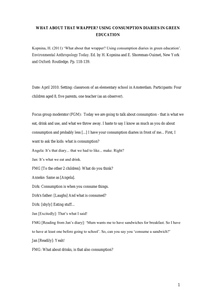
Environmental or ‘green' education is an important driving force behind the ‘greening' of society as it plays a critical role in raising environmental awareness and preparing students for green jobs. None of the existing environmental attitudes and behavior measures is focused on the evaluation of green education, especially in relation to consumption. To date, no longitudinal studies of children and students' attitudes towards consumption influenced by education exist. Also, little has been done to explore the socio-cultural context in which attitudes toward consumption are being formed and to explain the cross-cultural differences in environmental attitudes. This pilot study is designed to take the first step towards developing methods complementing existing quantitative measurements with qualitative strategies, such as consumption diaries, focus groups, and concept mapping. While this research is just a first attempt to tackle children's knowledge and attitudes consumption, preliminary results of the research on which this chapter is based and enthusiasm of the research participants encourage the author to stress the importance of consumption studies as part of green education for educational program developers. As a chapter of this volume, the author hopes that this study will add to the anthropological depository of research on the cultural variants in the perception of the environment in children. This chapter draws upon the consumption diaries collected from the upper-elementary school children in Amsterdam, The Netherlands, between September 2009 and May 2010. Consumption diaries are chronological documents recording purchase, use, and waste of materials, which can be used both as analytical tools and the means to stimulate environmental awareness. The four main methodological steps involved in this research were as follows. Children were asked to complete the consumption diary, paying specific attention to use and waste materials. Consequently, focus group meetings were held with parents and their children to discuss the diaries. Finally, interviews with the children were conducted in order to generate statements that supplement those generated by focus groups for carrying out the concept mapping analysis. The concept mapping analysis was then conducted to organize the order and analyze the ideas expressed in the focus group and interview sessions. This is an Accepted Manuscript of a book chapter published by Routledge/CRC Press in "Environmental Anthropology Today" on 8/5/11 available online: https://doi.org/10.4324/9780203806906 LinkedIn: https://www.linkedin.com/in/helenkopnina/
MULTIFILE
Personal data is increasingly used by cities to track the behavior of their inhabitants. While the data is often used to mainly provide information to the authorities, it can also be harnessed for providing information to the citizens in real-time. In an on-going research project on increasing the awareness of motorists w.r.t. the environmental consequences of their driving behavior, we make use of sensors, artificial intelligence, and real-time feedback to design an intervention. A key component for successful deployment of the system is data related to the personal driving behavior of individual motorists. Through this outset, we identify challenges and research questions that relate to the use of personal data in systems, which are designed to increase the quality of life of the inhabitants of the built environment.
DOCUMENT

CoSIE is een acroniem voor ‘Co-creation of Service Innovation in Europe’ . Het project staat voor het samen met burgers – in cocreatie – ontwerpen en verbeteren van sociale dienstverlening van de overheid om zo bij te dragen aan sociale inclusie en vernieuwing van de (lokale) democratie . Co-creatie is een gezamenlijke activiteit van overheid en burgers die tot doel heeft de waarde van publieke diensten te verrijken en te vergroten . Deze gezamenlijk activiteiten kunnen in elk stadium van ontwikkeling en implementatie van nieuwe diensten plaatsvinden . Individuele en publieke waarden kunnen worden begrepen in termen van toegenomen welzijn, gedeelde beleidsvisies of nieuwe diensten . Het CoSIE project heeft in heel Europa een beweging in gang gezet waarin onderzoekers en professionals samen met burgers werken aan een verbetering van publieke dienstverlening .
DOCUMENT

Kwantitatieve gegevens domineren sinds jaar en dag verantwoordings- en evaluatieprocessen en –systemen bij overheden en maatschappelijke organisaties, terwijl veel bestuurders, professionals en burgers beseffen dat dit maar een deel van de werkelijkheid vangt. Ze willen dat buurten veerkrachtig zijn, burgers in staat zijn zoveel als mogelijk de eigen regie te hebben, de verleende zorg en de toeleiding naar arbeid goed zijn, dat mensen ‘tot hun recht kunnen komen’. Maar hoe krijg je nu ‘goed zicht’ op die werkelijkheid, en op de impact die beleid en uitvoering daar hebben. Gemeenten, maatschappelijke organisaties en kennisinstellingen stellen zich in toenemende mate deze vragen, mede onder invloed van de transformaties in het sociaal domein.
DOCUMENT

Op 21 januari 2019 organiseerden het kennisplatform Utrecht Sociaal en de stichting Presentie een bijeenkomst over de identiteit van de nieuwe sociaal professional. Centraal stond de vraag wat kenmerkend is voor sociaal werkers die leefwereldgericht werken in wijken waar veel mensen in kwetsbare posities wonen en welke vaardigheden professionals daarvoor nodig hebben.
DOCUMENT
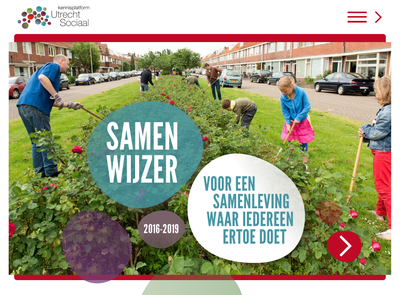
Het kUS, de Werkplaats Sociaal Domein voor de provincie Utrecht, startte in 2016 als opvolger van de Wmo-werkplaats Utrecht (2009-2016). Het kUS kon mede gerealiseerd worden door een subsidie van het Ministerie van Volksgezondheid, Welzijn en Sport (VWS).We gaven in de periode 2016-2019 met veel partijen uitvoering aan een gezamenlijk opgestelde kennisagenda. Dit deden we door middel van de zogenaamde vijf O’s: Ontmoeten,Ontsluiten, Onderzoeken & ontwikkelen, Opleiden en Ondersteunen.
DOCUMENT

Met deze publicatie vieren we 4 jaar kennisplatform Utrecht Sociaal (kUS). In deze publicatie krijgt u een indruk van de veelzijdigheid en impact van ons netwerk, ons kUS. Veel mensen in ons netwerk hebben een bijdrage geleverd aan dit boek. Hieruit blijkt de grote variatie aan activiteiten en de waarde die hieraan toegekend wordt door allerlei partijen. We hebben deze bijdragen geordend in blokjes waarbij de eerste vier hierboven genoemde O’s als kapstokjes gebruikt zijn. U zult merken dat de indeling van bijdragen in deze clustering nooit precies passend is, omdat – en dat is ook precies de bedoeling – veel O’s als olympische ringen met elkaar verbonden zijn. De O van ondersteuning hebben we niet gebruikt in onze indeling, juist omdat we in ons platform elkaar ondersteunen door middel van onderzoek & ontwikkeling, kennisontsluiting, bijeenkomsten en opleidingen.
DOCUMENT




